Event 1
Admission of nought students to Cross schools
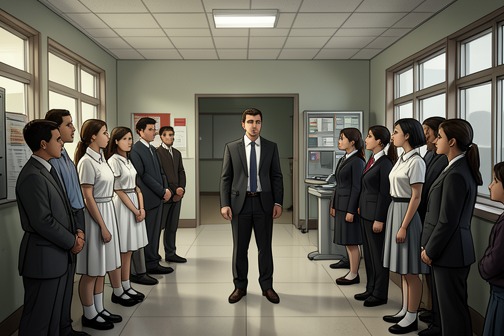
The admission of nought students to Cross schools is a government policy that brings nought pupils into institutions previously associated with Cross privilege, making [Heathcroft High](entity:location-recall-location-heathcroft-high-b3cb4db356c1) a test of whether formal access can alter a deeply segregated society. The policy is officially defended as compliance with a Pangaean Economic Community directive and as an opportunity for the most academically qualified nought youths; its arrival, however, is met by public hostility, unequal treatment, and political efforts to frame inclusion as a security threat.
## Policy and Political Context
The school opening is tied to external pressure for integration. [Kamal Hadley](entity:character-recall-character-kamal-hadley-0c49a552686e) publicly denies that the government acted because it was being blackmailed by the Liberation Militia, saying instead that it followed a P.E.C. directive that the government had already been close to implementing. His explanation frames the policy as a governmental decision rather than a concession to an illegal organization, while his reference to international pressure makes clear that the change did not arise in a political vacuum.
The government’s public rationale is explicitly selective. Kamal describes admitting the “crème-de-la-crème of nought youth” as socially and economically sensible and speaks of equality of education for noughts with sufficient aptitude. The promise of equality is thus qualified by selection: access is defended for a limited group deemed capable, rather than presented as an unconditional right for all nought children. That qualification sits uneasily beside the language of equal education and foreshadows the policy’s constrained reach.
The opening also becomes entangled with arguments about militancy. In a private conversation overheard by Callum, Kamal complains that the Pangaean Economic Community required schools to open to noughts and that the government had also been required to open police and armed-forces recruitment. He had expected admitting a few nought pupils to weaken the Liberation Militia, but argues that meeting one demand has only encouraged further demands. The contrast between the government’s public denial of capitulation and Kamal’s private account reveals how the same policy is presented differently according to audience: as principled implementation in public, and as a reluctant concession in private.
## Heathcroft: Admission and Protest
For Callum, admission turns an abstract policy into an immediate change in his life. On the eve of school, his father proudly calls Heathcroft High a beginning and takes pride in having a son who will attend it; his mother, by contrast, believes he is making a mistake. Their disagreement registers the risk attached to entry before Callum has even reached the school. His father sees the admission as a meaningful opening, while his mother anticipates its danger.
The hostility becomes visible when Callum approaches Heathcroft and finds a large crowd gathered outside. Cross protesters chant “NO BLANKERS IN OUR SCHOOL” while Callum and three other noughts are surrounded by police officers trying to move them toward the entrance. Police form an arm-linked line to push the Cross crowd back, but their presence does not make the arrival safe. Callum runs toward the school and pushes through the crowd, encountering the gap between the official act of admitting pupils and the resistance organized against their presence.
The school’s response is also compromised from within. A television report describes the admitted pupils as having met “some hostility,” but Callum notes that the broadcast leaves out the police officers’ failure to protect them from people who poke, pinch, and punch them, as well as the Cross spit covering the back of his jacket. His account directly contradicts the minimizing news language. The report makes the confrontation seem limited; the omitted details show that the students’ treatment was more sustained and that the cameras’ selection of what to show shapes what the public is allowed to recognize.
## Institutional Resistance and Everyday Prejudice
The policy’s implementation encounters opposition among school authorities as well as outside the gates. Callum overhears Mr Costa tell [Mrs Paxton](entity:character-recall-character-mrs-paxton-a89c7b5539e1) that if the blankers find Heathcroft difficult, they may have to go elsewhere. Mrs Paxton counters that nought pupils are constantly being picked on and warns that one of them may retaliate. Her concern is not simply that the policy has provoked conflict; she identifies the school’s failure to act against persistent harassment as a condition that could intensify it.
Mr Costa insists that the government admitted the pupils only because the Pangaean Economic Community ordered it to do so and feared sanctions. Mrs Paxton rejects the relevance of that motive: the pupils are already there, she argues, and the school must act if the scheme is not to fail. Her exchange with Costa exposes two opposed understandings of responsibility. He treats admission as an externally imposed inconvenience; she treats the students’ presence as an obligation that must be met through action within the school. His willingness to suggest that they leave shows how institutional authority can undermine the access the policy formally grants.
Prejudice also travels through ordinary conversation and media consumption. Cross girls at Heathcroft claim they have already encountered blankers when being served in shops and restaurants, then say that those they see on the news belong to the Liberation Militia and cause trouble and commit crimes. Their confidence rests not on meaningful contact with the admitted pupils but on a generalized picture supplied by news coverage. In this way, the school’s integration is resisted not only through direct protest but through assumptions that collapse nought identity into criminality.
## Wider Consequences and Significance
The school policy unfolds amid a climate in which the Liberation Militia and the state’s response dominate news coverage. A broadcast connects the group to demands for political change, while Kamal promises that noughts who join it will find no safe haven. This context makes nought admission vulnerable to being treated as part of a security bargain rather than as an educational question. The result is a public debate in which the existence of a limited opening can be used both to claim that equality is being addressed and to argue that noughts remain a threat.
The surrounding story extends the same pattern of institutional scrutiny beyond the school. At a hospital, a nurse explains that government rules require patients’ identity cards to be checked and registered before care is administered. Later, the court presents [Dundale Shopping Centre](entity:location-recall-location-dundale-shopping-cen-fa026bd7f99a) surveillance footage as material assembled by the police, the prosecutor’s office, and two independent witnesses from prominent nought groups. These episodes do not constitute the school policy itself, but they reinforce the institutional setting in which nought identity is repeatedly recorded, assessed, and made politically consequential.
The consequences of the school opening are therefore larger than the placement of a handful of pupils in Cross institutions. Heathcroft becomes a public measure of inclusion whose result is shaped by protest outside its gates, hostility within its administration, selective news coverage, and political claims about militancy. The policy offers formal entry, but the pupils’ experience shows that access alone does not dismantle the social hierarchy governing who is welcomed, protected, or believed. The contrast between Callum’s father’s pride in the new beginning and the school’s failure to secure that beginning gives the admission its central significance: it makes equality visible as a promise while exposing the structures that keep that promise precarious.
Event 2
Heathcroft 首日抗议
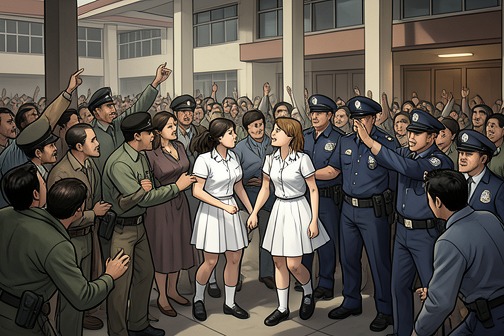
The Heathcroft first-day protest is the violent public welcome given to Callum and three other Nought students at [Heathcroft High](entity:location-recall-location-heathcroft-high-b3cb4db356c1). As a crowd of [Crosses](entity:concept-recall-concept-crosses-47abf27d378b) chants against their presence and police fail to protect them from assault, Sephy intervenes by repeating the same racist slur she is trying to silence. Callum hears the word as a personal betrayal, and the protest becomes a decisive break in their closeness as well as a concentrated demonstration of how school exclusion is enforced through crowd hostility, compromised policing, and the language of racial hierarchy.
## The demonstration at the school
Sephy first hears the protest as a distant rumble and a swell of angry shouting. Rounding the corner, she sees a huge crowd outside the school and freezes before moving toward it, first walking and then running. The slogan, repeated over and over, demands that [Noughts](entity:concept-recall-concept-noughts-1aaaa6ffdea4) be kept out of the school. The chant turns their admission into a public confrontation before they can even enter the building.
Callum and three other Nought students are surrounded by police officers attempting to push through the crowd toward the school entrance. Other officers form an arm-linked line, trying to divide the Crosses into two orderly groups and force them back. Sephy pushes and elbows her way through the gathering, calling for Callum, but the crush makes it difficult to see him. Her friends Julianna, Adam, and Ezra are among the demonstrators; most painfully, her sister Minnie is there too, shouting with the crowd.
The Nought students try to make their way up the school steps. The crowd surges forward, its anger experienced by Sephy as a physical blow, and a sudden cry announces that someone has been hurt. Callum’s head dips, as do the police officers’ heads. Sephy has already asked [Mr Corsa](entity:character-recall-character-mr-corsa-ef6ee45ad7b7) to help a hurt girl, but he does not move when she repeats the request. The scene thus presents authority not as a reliable barrier between the crowd and its targets, but as part of a chaotic response in which the danger is visible and help is not forthcoming.
## Sephy intervenes—and repeats the insult
Sephy shouts for everyone to stop. When the first appeal has no effect, she raises her voice until her throat hurts and calls the crowd animals, then says they are worse than animals—like the very people they are abusing. The noise slowly dies away. Her words achieve an immediate change in the scene: the crowd falls quiet enough for her to look down at Callum, who is staring at her with a strange expression.
Her intervention is a desperate attempt to redirect the insult at the Crosses and make them recognize their own cruelty. But she uses the slur itself, and its target cannot be controlled by the intention she privately attaches to it. Sephy internally insists that she did not mean Callum and would never mean him; she tells herself that she used the word only to stop the others and get help. The divide between that intention and what Callum hears is the event’s central reversal: the speech that arrests the crowd also wounds the person Sephy most wants to protect.
## The rupture between Callum and Sephy
Callum does not treat the word as a harmless phrase that an apology can erase. He tells Sephy that a slap, punch, or even a stabbing would eventually stop hurting, but that he will never forget what she called him. The contrast makes the insult’s injury enduring rather than physical: the word comes from someone whose regard matters to him, in front of a hostile crowd that is already declaring Noughts unwelcome.
Sephy wipes her cheeks and says she did not mean him, explaining that she was trying to help. Callum responds that perhaps they should not see so much of each other anymore. Her apology does not restore their previous closeness, and his answer makes plain that good intention cannot simply cancel the force of the act. The protest therefore produces two forms of harm at once: the immediate danger to the Nought students in the crowd, and the intimate damage done when Sephy’s attempt to oppose public racism repeats its language.
## School policy, policing, and public narration
The protest belongs to a larger conflict over whether Nought students can attend Heathcroft High at all. Later, the headmaster, Mr Costa, argues that if Nought students are finding school difficult, they should go elsewhere. [Mrs Paxton](entity:character-recall-character-mrs-paxton-a89c7b5539e1) counters that they are constantly being picked on and warns that one of them may retaliate. Their exchange exposes the difference between treating hostility as a reason for Nought students to leave and recognizing that those students are being targeted. The confrontation outside the school makes Mrs Paxton’s warning concrete: exclusion is not simply a matter of admission rules, but a daily danger produced by what happens after the students arrive.
The police presence does not prevent the crowd from reaching the students. Callum later recounts that officers assigned to guard the Noughts let people get close enough to poke, pinch, and punch them, while the back of his jacket was covered in Cross spit. His account adds the bodily consequences that Sephy could not fully see in the crush and contests the image presented on television. The news report describes the admitted students as having met with “some hostility,” a mild formulation that Callum recognizes as euphemism. The contrast between the violence at the school and its softened public description shows how discrimination can be obscured as well as enacted.
The protest’s significance also lies in its recurrence through the institutions around the characters. Nought students are subjected to hostility at school, while official procedures elsewhere demand identity cards before medical care can be given; Sephy’s mother invokes a proverb about lying down with dogs to blame Sephy for her association with Callum and his family. These are distinct moments, but together they show how the boundary enforced by the crowd is echoed in policy and private speech. At Heathcroft, the chant makes that boundary audible, the police fail to contain it, and Sephy’s attempt to challenge it reveals how easily its language can enter even a protest against its cruelty.
Event 3
Meggie 被 Hadley 家解雇

Meggie’s dismissal from the Hadley household turns a moment of misunderstanding into a lasting loss of security for the McGregor family. After Meggie unknowingly provides an alibi for Mrs Hadley, Mrs Hadley blames her for failing to help when she needed it, then terminates her employment. The lost wages threaten [Jude](entity:character-recall-character-jude-c859762b9a2d)’s education, and Meggie’s effort to reverse the decision ends on the night [Lynette](entity:character-recall-character-lynette-71e9799b4a32) disappears.
## The confrontation and the broken trust
Meggie’s dismissal follows a visit in which she tells Kamal and Mrs Hadley that she and her family stayed home watching television the previous evening. Kamal initially accepts the answer as an ordinary account of a quiet night with family. The mood changes when he rises, approaches his wife, and strikes her. Meggie reacts in horror and goes to Mrs Hadley’s side, but Mrs Hadley refuses her help.
Mrs Hadley’s rebuke makes clear that the harm between the women is not simply a response to the confrontation. She tells Meggie that when she needed help, Meggie did not give it. Only then does Meggie understand that Mrs Hadley had used her, without Meggie realizing it, as an alibi for the previous night. Meggie had answered Kamal’s question too slowly to recognize what he was really asking. The exchange turns her ordinary recollection into evidence in a private conflict she did not know she had entered, and Mrs Hadley treats that failure of understanding as a breach of trust.
## The decision to dismiss Meggie
The end of Meggie’s employment is communicated indirectly: Sarah calls to say that Mrs Hadley no longer requires Meggie’s services. The offer of four weeks’ wages in lieu of proper notice and a good reference does not soften the news. Meggie is stunned; she had not expected to be dismissed.
The consequences become clear when Meggie puts down the phone. She says that Jude’s education is over, while Ryan reminds her that they had promised to pay for him to continue at school. Meggie challenges the prospect of finding the money: without her wages, she says, the family can barely manage, Jude will have to leave school and go to work. Ryan suggests that she will find another job, but Meggie doubts she can work for another Cross family if Mrs Hadley would prevent her from being hired by one of her friends. The dismissal therefore reaches beyond the loss of one position: it threatens a promise the family had made to their son and narrows Meggie’s prospects for replacing her income.
## Meggie’s attempt to get her job back
Meggie refuses to accept the loss without trying to change it. She tells Ryan that she is going to see Mrs Hadley, pointing out that she has worked for her for fourteen years, since Mrs Hadley was pregnant with [Minerva](entity:character-recall-character-minerva-fc023ce135f2). In Meggie’s view, that history alone makes a meeting the least Mrs Hadley can offer. Ryan warns that going is not a good idea, but Meggie insists that she needs her job back and is prepared to beg for it.
Her determination is practical as well as emotional: the household needs her wages, and Jude’s schooling depends on them. She pulls on her coat and leaves before Ryan can argue further. Two hours later she returns. The account does not state what happened in the meeting or explicitly describe its outcome, but it gives no indication that Meggie regained her position. Instead, it marks the night of her return as the night Lynette disappeared, placing a new family crisis immediately after Meggie’s effort to repair the first.
## Consequences and narrative significance
The dismissal binds employment to the McGregors’ limited choices within a society divided between [Crosses](entity:concept-recall-concept-crosses-47abf27d378b) and noughts. Meggie believes Mrs Hadley’s influence may keep her from finding work in another Cross household, so the decision threatens not just a job but the family’s ability to sustain Jude’s education. The difference in power is present in the practical terms of the dismissal: Mrs Hadley can end the employment and offer a reference, while Meggie has to contemplate begging to recover the income her family needs.
Later, the consequences of the loss and the unresolved confrontation remain part of the family’s grief over Lynette. After Lynette dies, Meggie turns on her family, asking whether they are proud of themselves and whether Lynette had her mind on what they had said to her. That later accusation does not establish a direct cause between the dismissal and Lynette’s death, but it shows how Meggie understands the family’s recent words and actions as part of a painful chain of events. Lynette’s own letter to Callum describes her despair at living in a world where being a nought means that nothing she does will ever be good enough. The sequence gives Meggie’s dismissal a place within the broader pressures surrounding the family, without making the lost job alone responsible for what follows.
Event 4
Sephy 因与 nought 学生交往而遭殴打
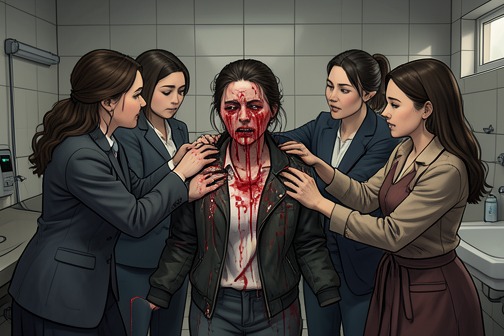
Sephy’s assault by Lola, Joanne, and Dionne is the violent consequence of her choosing to sit with Nought students at Heathcroft. In the school toilets, her classmates demand that she keep to her own kind; when she refuses their racial logic, they slap and beat her. Sephy fights back, but the attack makes clear that friendship across the Nought–Cross divide is policed not only by school customs and public hostility, but by threats of exclusion and physical force.
## Causes and School Context
The confrontation grows out of the school’s segregated social order. Earlier, a crowd had gathered outside Heathcroft chanting against Nought students, while police tried to control the crowd and reach the entrance. Sephy later saw how the television report softened what happened: it described the new Nought students as meeting “some hostility” and omitted that the police had allowed the crowd to reach them, where they were poked, pinched, and punched. The back of Sephy’s jacket was covered in spit. The assault in the toilets therefore takes place within a broader pattern: open hostility is minimized in public accounts even as it is experienced directly by students.
The immediate pretext was Sephy’s presence at the [Noughts](entity:concept-recall-concept-noughts-1aaaa6ffdea4)’ table in the food hall. She had been avoiding the school corridors and, above all, Callum, afraid to face him after what had happened the previous evening and hoping that avoiding him might let her pretend their friendship had not changed. When she finally left a toilet cubicle, Lola, Joanne, and Dionne pushed her back inside and crowded in after her. Their choice of the enclosed space made the confrontation an ambush, separating Sephy from the school’s ordinary public spaces and leaving her alone with the three girls.
## The Assault
Joanne named Sephy’s offence plainly: she had sat at the “blankers table.” Sephy challenged the girls to explain why they cared. Lola answered with a slap, which shocked Sephy less because of its force than because nobody had hit her before, not even her sister, [Minerva](entity:character-recall-character-minerva-fc023ce135f2). Lola then warned her that if she sat with Noughts again, the whole school would treat her as one of them. Joanne reinforced the demand by telling Sephy to recognize which side she belonged on. Their threat was not simply that she would be hurt again, but that solidarity with Nought students would cost her place among Cross classmates.
Sephy initially imagined that Callum might enter and stop the attack. Instead, Lola pushed her down when she tried to stand and held her by the shoulder. Lola warned that Sephy would have no friends left if she did not stay away from Noughts. When Sephy asked why the girls hated them, Joanne treated service work in shops and restaurants as sufficient grounds for claiming she had spoken to Noughts. Lola recited the insult behind that hierarchy: Noughts were supposedly blank in appearance and mind, and therefore fit to serve [Crosses](entity:concept-recall-concept-crosses-47abf27d378b). Sephy rejected the claim as ignorant and insisted that Noughts were people like them.
Lola slapped her again. This time Sephy was ready: she punched Lola in the stomach, then fought with her fists, elbows, and feet. The burst of resistance briefly gave her the element of surprise, but Joanne and Lola seized her arms. Dionne, known as the best fighter in her year, then faced her. Calling Sephy a “blanker-lover,” Dionne said she had had the attack coming for a long time before joining in. The movement from verbal warning to two slaps and a group beating shows how quickly the girls’ demand for conformity becomes physical punishment once Sephy openly defends Noughts.
## Institutional Silence and Aftermath
The school’s adults offer no immediate protection within the assault scene: Sephy is attacked in a toilet cubicle, and the prospect of someone intervening exists only in her anxious expectation that Callum will arrive. Elsewhere, the institutional response is shown as compromised. [Mrs Paxton](entity:character-recall-character-mrs-paxton-a89c7b5539e1) tells Mr Costa that Nought students are constantly picked on and warns that one will eventually retaliate. Mr Costa replies that if they find Heathcroft difficult, they should go elsewhere. His response shifts responsibility from the school’s failure to protect Nought students onto the students themselves, echoing the attackers’ demand that Sephy accept the racial division rather than challenge it.
Afterward, Callum asks who hurt her. Sephy identifies Lola, Joanne, and Dionne, specifying that they are in Mrs Watson’s class, then tells him it is over. The exchange confirms both that the attack is known to Callum and that Sephy does not describe her resistance or injury as a reason to withdraw from him or from the Nought students. Her account is brief, but the contrast is telling: the assailants tried to make her choice carry a lasting social cost, while Sephy insists on setting the terms of what happens next.
## Significance
The assault turns a seemingly small school choice—where Sephy sits at lunch—into a test of the racial order. Lola’s warning makes the consequence explicit: to sit with Noughts is to risk being treated as one of them. Sephy’s defence of Nought students does not erase her position as a Cross or make the violence symmetrical; she is a member of the privileged group whose solidarity is punished by other Cross students, while the wider school has already admitted Nought pupils into a hostile environment and failed to represent that hostility honestly on television.
The episode also links public language to private violence. The chant outside the school, the euphemistic news report, the insults in the toilet, and Mr Costa’s suggestion that Nought students leave all help preserve the same boundary in different forms. Sephy’s blows interrupt that pattern in the immediate encounter, but do not undo the institutional conditions that made the attack possible. The event marks her refusal to treat friendship with Callum and the Nought students as a private matter that can be separated from the school’s rules of belonging.
Event 5
Lynette 因与 Cross 交往而遭袭
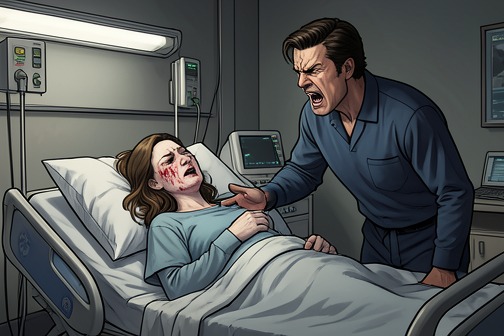
[Lynette](entity:character-recall-character-lynette-71e9799b4a32)’s assault by Nought men because she was dating a Cross is the concealed cause of the profound change in her life: after the attack, she withdrew from the world around her and could rarely communicate with her family. The truth emerges only three years later, when her father explains what happened and why the family had hidden it. The revelation connects private trauma to the racial hostility surrounding relationships between [Noughts](entity:concept-recall-concept-noughts-1aaaa6ffdea4) and [Crosses](entity:concept-recall-concept-crosses-47abf27d378b).
## The Hidden Attack
Three years before the family’s disclosure, Lynette and her boyfriend were attacked by three or four Nought men. Her boyfriend was beaten nearly to death, and Lynette was injured badly enough to remain in hospital for more than two weeks. She begged her parents not to tell her siblings what had happened, and they concealed the circumstances from them.
The family’s cover story was that Lynette had gone to stay with Aunt Amanda, who was supposedly ill and needed care. Her siblings were therefore left without an explanation for her absence or for the lasting change they saw when she returned. The secrecy was not simply a gap in their knowledge: it shaped how they understood Lynette and left them unable to connect her isolation to the violence she had endured.
## Cause and Consequences
Lynette’s father identifies the reason for the attack: her boyfriend was a Cross. The violence made the racial taboo against Nought–Cross relationships more than a social prohibition; it became a physical threat borne by Lynette and her partner. Her father also explains that she feared her family’s reaction, suggesting that hostility toward the relationship reached beyond the attackers and into the expectations Lynette anticipated at home.
The assault’s consequences persisted long after the hospital stay. Lynette’s sister remembers that she had once looked after her when their mother had to work, but that after the incident she rarely went out or spoke and seemed to inhabit a private world. Her father says her mind had not been right since the attack and that she could no longer bear to think of herself as one of the Noughts. The account presents withdrawal as the aftermath of severe trauma, while also showing how the family’s silence delayed their understanding of it.
## Disclosure Within the Family
The truth comes out during a confrontation between Lynette’s father and [Jude](entity:character-recall-character-jude-c859762b9a2d). After Jude turns away from him, their father slaps him, an unprecedented act in the household, and rebukes him for judging Lynette without knowing what she had endured. Jude’s question prompts the explanation: the supposed visit to Aunt Amanda had hidden the assault and the reason for it.
The disclosure changes the family’s understanding of Lynette. Her sister realizes that the withdrawn person at the table is not simply distant or difficult to reach; her present condition follows an attack whose real circumstances had been kept from them. Jude, who had not known the truth, stops challenging her, and their father insists that the family leave her alone. The scene makes knowledge itself consequential: what had looked like inexplicable separation becomes legible as the continuing effect of violence and concealment.
## Narrative Significance
The event links Lynette’s private suffering to the wider racial order of the novel. She and her boyfriend are attacked by members of her own racial group because he is a Cross, showing that the prohibition on intimacy across the Nought–Cross divide is enforced not only through public hostility but through violence within a community and the fear it produces within a family.
Its delayed revelation also gives the assault a structural role in the family narrative. The siblings have lived for years with a false explanation; when their father finally supplies the truth, it reframes Lynette’s absence, her isolation, and the family’s earlier silence at once. Her story is not presented through a detailed account of the attack itself, but through its enduring consequences and the painful moment when those consequences become understood.
Event 6
Jude 揭开 Lynette 遭袭的真相
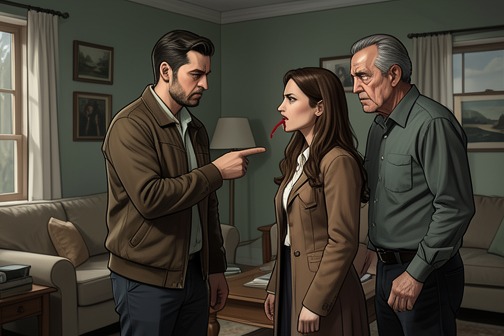
The revelation of the truth about [Lynette](entity:character-recall-character-lynette-71e9799b4a32)’s attack overturns [Jude](entity:character-recall-character-jude-c859762b9a2d)’s assumptions about his sister: she was not simply choosing to separate herself from her family, but living with the consequences of a brutal assault by Nought men after she dated a Cross. Their father’s account connects the violence to Lynette’s long withdrawal and disorientation, and makes Jude confront the history behind the anger he has directed at her.
## The confrontation at home
When the family comes together during one of Lynette’s episodes, Jude is shouting at her. At first, Callum thinks the scene is familiar: Jude winds his sister up, and she does not answer him. But this time Lynette shouts back. She and Jude square up to each other while their father tries to keep them apart; Jude’s lip is bleeding. The exchange is not just a sibling quarrel. It brings into the open the opposing ways they understand who belongs and what their Nought identity means.
Jude accuses Lynette of acting as if she is too good to share the air with the rest of them. He says that, to the people he calls daggers, she looks as white as he does, whatever her airs and graces. Lynette insists that she is different and points to her dark skin as proof that she is brown. Her protest makes visible a rupture between her appearance and her sense of herself: she can name her family’s identity, but no longer feels that she can inhabit it.
## Their father reveals the attack
When Jude asks what Lynette has been through, their father explains that three years earlier she and her boyfriend were attacked by three or four Nought men. The assault took place during a period when the family was already under strain: Jude had to leave school after his mother lost her job, and Lynette was away from home. Her parents told the children she had gone to care for an ill Aunt Amanda. In reality, the men had beaten Lynette’s boyfriend almost to death and injured Lynette so badly that she spent more than two weeks in hospital.
The family had concealed what happened because Lynette begged them not to tell the others. Their father also explains why she was attacked: her boyfriend was a Cross. Lynette had been beaten and left for dead for crossing the racial boundary through a relationship. She had feared what her family would say, and the injury continued long after she left hospital. Their father links the attack to her inability to bear thinking of herself as one of the [Noughts](entity:concept-recall-concept-noughts-1aaaa6ffdea4), her difficulty leaving the house, and the state of her mind. He tells Jude to stop judging her when he does not know what she has endured.
The disclosure changes the argument’s terms. Jude’s talk of daggers and his accusation that Lynette considers herself superior had treated her distance as an insult. Their father reveals that her separation is bound up with a violent experience she had tried to keep secret, and with the racial hostility that made her relationship dangerous. Jude says he did not know and reaches a hand toward her; Lynette slaps it away. His attempt to approach her cannot undo either the attack or the years in which the truth was hidden from him.
## Lynette’s disorientation
The confrontation turns from family history to Lynette’s immediate distress. Her palms are bleeding after she strikes a cracked mirror. She stares first at the blood and then at her reflection as if she does not recognize either. When she asks where Jed is, her father tells her that he went away a long time ago and tries to clean her hands. Lynette withdraws them. Her former, faraway expression is gone; she asks where she is, and her father answers that she is home and safe.
Lynette’s questions about Jed and her uncertainty about where she is place the disclosed attack beside the continuing damage it has left in her life. The scene does not present the revelation as a cure or an explanation that makes her suddenly well. Instead, it shows a sister whose sense of time and self has become unstable, while the people around her can offer reassurance but cannot restore what has been lost.
## The failed reconciliation
Jude stretches out his hand and tells Lynette that he did not know. She strikes his hand away and tells him to keep it away from her. Jude interprets the rebuff through the racial language that has taken over his speech, asking whether she means his Nought hands. Lynette looks down at her own hands and answers that his are the same as hers, and the same as theirs. She then runs upstairs before anyone can respond.
Her answer refuses the separation Jude has tried to make between himself and the people he calls daggers: their hands are alike, and the shared identity he invokes cannot be escaped by treating Lynette as an outsider. Yet the recognition does not settle the conflict. She leaves, and their father and Jude look lost. Callum, watching them, sees his own face in the mirror and recognizes that his expression, thoughts, feelings, hatreds, and fears are theirs as well as his. The disclosure therefore reverberates beyond the brother and sister: the family’s pain and inherited divisions are not confined to the person who speaks loudest or the person who was attacked.
## Consequences and significance
The revelation supplies the history that Jude lacked, but it does not bring the family back together. It changes how his treatment of Lynette can be understood: what he had taken for pride or rejection is also connected to an assault she concealed, fear of her family’s judgment, and lasting trauma. His ignorance explains the gap in his understanding, but his outstretched hand is still refused; knowledge arrives after harm has already shaped their relationship.
Lynette’s experience also makes the racial conflict concrete within the McGregor household. She was attacked by Nought men for dating a Cross, while Jude’s increasingly frequent use of the word daggers shows how racial hostility has become part of his own everyday speech. The episode places the consequences of that hostility beside the family’s effort to protect Lynette by hiding the truth. Their cover story kept the assault from the children, but it also left Jude without the history needed to understand his sister. The scene’s final recognition—in which Callum sees his own feelings reflected in his father and brother—extends the revelation into a wider account of shared family pain, without suggesting that shared feeling can erase the divisions that produced it.
Event 7
Kamal 与 Jasmine 宣告婚姻破裂
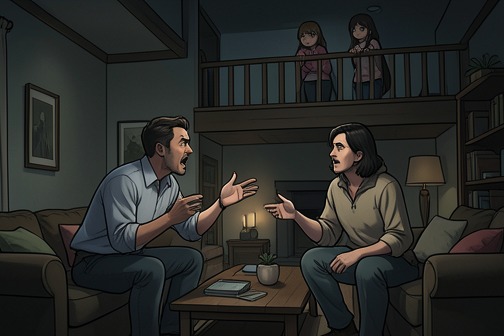
[Kamal Hadley](entity:character-recall-character-kamal-hadley-0c49a552686e) and [Jasmine Hadley](entity:character-recall-character-jasmine-hadley-79d5e004aa46)’s marital rupture becomes explicit in an argument their daughters overhear from the stairs. The exchange turns a private separation into a family revelation: Kamal identifies an earlier conflict over his son as a lasting grievance, refuses Jasmine’s attempt at reconciliation, and says he will make their separation official after the next election. The scene also shows their daughters learning, in the midst of the break, that they have a brother.
## The argument and its audience
The confrontation takes place at home while [Persephone Hadley](entity:character-recall-character-persephone-hadley-eb8440fea67a) and [Minerva Hadley](entity:character-recall-character-minerva-hadley-189a580f0bca) are upstairs, supposedly doing homework. Their mother has sent them away from the family room, a departure from her usual habits that alerts them that something is happening. The sisters listen as their parents argue below, making the separation both an intimate dispute and a revelation witnessed by the children it will affect.
Kamal’s contempt is plain from the outset. When Jasmine tells him she will not accept being treated as he is treating her, he answers by disparaging her drinking. The argument then moves from present resentment to an older family wound, with each parent interpreting the other’s conduct as evidence of betrayal and blame.
## The earlier wound over Kamal’s son
Jasmine’s accusation that she was expected to admit Kamal’s son into their home brings the hidden source of the conflict into the open. Kamal replies that the boy was born before he and Jasmine met, and mocks the idea that Jasmine would have had to sacrifice her comfort or social standing to raise him. Jasmine concedes that she should have accepted the child, but explains that she was hurt when Kamal first told her and calls her rejection a mistake.
Kamal does not accept that apology as a basis for repair. He says that marrying Jasmine was his own mistake and accuses her of spending years punishing him because of his son. As the sisters listen, they understand for the first time that Kamal has a son and that they have a brother. The marital quarrel thus changes their knowledge of their family even as it confirms that their parents’ relationship is failing.
## A rejected attempt to begin again
Jasmine hesitantly proposes that she and Kamal might start again, just the two of them, perhaps by going away together. Kamal interrupts and dismisses the proposal. His refusal makes clear that, for him, the marriage is not at a temporary impasse awaiting a shared decision: he considers it finished.
The exchange also establishes the different accounts each parent gives of their life together. Jasmine’s words suggest a hope for renewed partnership; Kamal says that he has already left emotionally and that she refused to recognize it. His statement reframes the separation as something long underway, rather than a decision made for the first time during this argument.
## Separation and parental obligations
Kamal answers Jasmine’s charge that he is leaving her and their children by naming Grace, but rejects the suggestion that he is only now walking out. He promises that Jasmine and the children will have what they need and says they will be well provided for. He also insists that he wants regular access to his daughters because he loves them and does not want Jasmine to turn them against him.
The separation is therefore presented not as the immediate abandonment of his children, but as the end of the marriage accompanied by a proposed arrangement for support and continued contact. Kamal says he will make the separation officially known after the next election, giving the break a political timetable as well as a domestic one. Jasmine threatens divorce and exposure in the newspapers; Kamal laughs at the threat and says that her divorcing him would make him happy. Their exchange ends without reconciliation, leaving the marriage’s breakdown unmistakable and the family’s future contested.
Event 8
Lynette McGregor's suicide
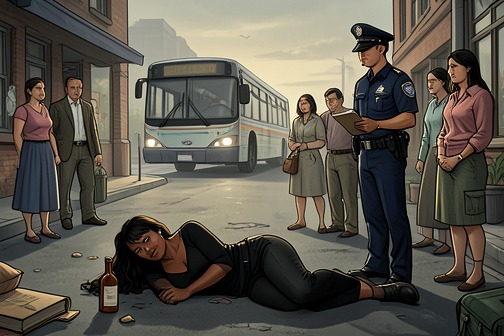
[Lynette McGregor](entity:character-recall-character-lynette-mcgregor-c330e3535556)’s suicide is a concealed death whose meaning changes when her letter to [Callum McGregor](entity:character-recall-character-callum-mcgregor-50a89b03e1a0) reveals that she deliberately walked into the path of a bus. The family is initially told that she died in an accident; [Lynette](entity:character-recall-character-lynette-71e9799b4a32)’s account instead links her decision to a life shaped by despair and the conviction that, as a nought, she could never be considered good enough. Her death becomes both a private family tragedy and part of the story’s wider pattern of loss under racial oppression.
## The Reported Accident
A police officer tells the McGregor family that Lynette walked into the path of an oncoming bus. Witnesses had said she seemed absorbed in her own thoughts, and the officer describes the death as an accident, adding that she was killed instantly. The family receives this account before it knows that Lynette had intended to die.
The official explanation does not settle the family’s response. Callum’s mother, [Meggie McGregor](entity:character-recall-character-meggie-mcgregor-49b9f7269554), turns to the children and asks whether they are proud of themselves, then questions whether Lynette might have been thinking about what they had said to her. [Ryan McGregor](entity:character-recall-character-ryan-mcgregor-4cbbf931afd1) answers that the officer called it an accident, but Meggie continues to grieve for her child. The scene places an unresolved question of responsibility alongside the police account, without establishing that the family caused Lynette’s death.
## The Letter and Its Disclosure
Afterward, Callum finds a letter from Lynette addressed to him. She writes that she is tired and wants to escape, and explains that she chose a route she believed could be made to look like an accident so that her parents would not be shamed. Her letter therefore overturns the account given to the family: the bus collision was not an accident, but a suicide Lynette had planned to conceal.
Lynette also makes clear that she is no longer ashamed of who she is. Her despair instead comes from believing that the society around her will never regard her as good enough because she is a nought, and that nothing she does can change that condition. In the same letter, she hopes Callum and [Persephone Hadley](entity:character-recall-character-persephone-hadley-eb8440fea67a) will have better luck than she and Jed, and tells Callum to be strong for both of them. The message combines an intimate farewell with a stark account of the social pressure she could not endure.
## Grief and the Family’s Response
The letter gives Callum knowledge that the rest of the family does not share in the initial aftermath. The family first has to respond to Lynette’s death through the public description of an accident, while Meggie’s anguished question brings the family’s recent words to the fore. The difference between the official explanation and Lynette’s private account leaves grief entangled with uncertainty and guilt.
The novel later places Lynette’s death beside Ryan McGregor’s execution. At the prison, Ryan is formally announced as having been found guilty of seven counts of murder and political terrorism, and sentenced to death by hanging. The two deaths are distinct: [Lynette’s suicide](entity:action-recall-action-lynette-s-suicide-e1adafc56c10) is presented to her family as accidental, while Ryan’s death is carried out as a state punishment. Their juxtaposition widens the family’s losses from intimate bereavement to public, politically charged death.
## Continuing Consequences
Months after Ryan’s execution, Callum says that his father was killed in July and that something in him died with his father. He rejects the authorities’ classification of Ryan’s death as suicide, expressing the nought community’s belief that the official account conceals what happened. Callum’s grief over Ryan is not the same as his earlier grief over Lynette, but the recurring conflict between public explanations and private knowledge binds the losses together.
The event’s narrative force comes from delayed disclosure: the family hears that Lynette died in an accident before Callum reads the letter that reveals her intention. That reversal does not resolve blame; instead, it makes the reader reconsider the officer’s account, Meggie’s question, and the social conditions Lynette names. Her death exposes the distance between a death’s public description and the truth a person leaves behind for someone who loved her.
Event 9
Sephy's mother's suicide attempt
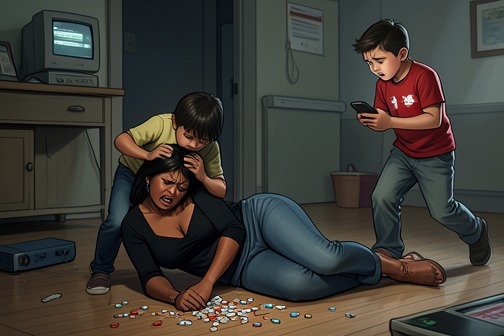
Sephy’s mother’s suicide attempt is a family crisis discovered by Sephy and [Minerva](entity:character-recall-character-minerva-fc023ce135f2). The scene turns Sephy’s private anger at her family’s troubles into urgent responsibility, while the novel’s later references to [Lynette](entity:character-recall-character-lynette-71e9799b4a32)’s death and [Ryan McGregor](entity:character-recall-character-ryan-mcgregor-4cbbf931afd1)’s execution place the attempt within a wider pattern of grief, despair, and unresolved loss.
## Discovery and Immediate Response
Before the attempt is discovered, Sephy has withdrawn to the sofa, frustrated by her sister’s moods and convinced that one person cannot change what is happening between their parents. Minerva’s urgent call for an ambulance breaks through that self-absorption. Sephy runs upstairs and finds her mother slumped on the floor beside a tablet bottle, with a few pills scattered nearby; Minerva is supporting her mother’s head and calling her name.
Minerva orders Sephy to get help, and Sephy runs to the phone, recognizing that her mother has tried to kill herself. The change is abrupt: resentment and helplessness give way to an emergency in which both sisters act to summon medical assistance. The evidence establishes the attempt and their response, but does not describe the mother’s subsequent treatment or recovery.
## Family Grief and Blame
The attempt occurs amid a household already strained by loss. After Lynette’s death, Meggie accuses the children of having reason to be proud of themselves and asks whether Lynette had her mind on what they had said to her. Ryan answers that the officer called the death an accident, but Meggie’s question leaves the family facing the possibility that their words contributed to Lynette’s despair. The connection is presented as Meggie’s anguished suspicion, not as proof that the children caused the death.
This earlier grief gives the later discovery a painful family context: Meggie’s crisis unfolds in a household where sorrow has already become accusation and where the children have witnessed a parent’s devastation. Sephy’s own thought that her mother tried to kill herself registers the event as a rupture in the family, rather than merely another argument between adults.
## The Letter and Its Meaning
In a letter to Callum, Lynette describes her wish to die and says she intends to make her death look like an accident so that she will not shame her parents. She connects her despair to being a Nought in a world where she believes she will never be good enough, and offers Callum advice to be strong. The letter makes explicit the kind of concealed despair that the family fears may have been present before her death, while preserving the distinction between Lynette’s death and Meggie’s later attempt.
The events therefore present suicide-related despair in two different forms: [Lynette’s letter](entity:object-recall-object-lynette-s-letter-abc6eac714e3) describes an intention hidden from her family, while Meggie’s crisis is discovered by her daughters, who immediately seek help. The contrast links private suffering to family silence and the social pressures named in Lynette’s letter without suggesting that the two events have identical causes or outcomes.
## A Wider Pattern of Loss
The attempt is not the only crisis of despair in the novel. Following Ryan McGregor’s execution, Callum thinks that something in him died with his father and says that he and other [Noughts](entity:concept-recall-concept-noughts-1aaaa6ffdea4) believe the authorities’ account of suicide is false. The contrast between an officially described death and the family’s conviction about what happened extends the novel’s attention to grief into public and political life.
Later, Sephy tells [Jude McGregor](entity:character-recall-character-jude-mcgregor-f953aa53e232) that she could have saved Callum but did not, and says she cannot live with that any more. Her words describe her own guilt and anguish; they do not establish that she attempts suicide. Read alongside Meggie’s attempt, the exchange shows how loss continues to shape family relationships and how despair can be voiced as blame, self-reproach, or a plea for help.
Event 10
Dundale Shopping Centre bombing

The [Dundale Shopping Centre bombing](entity:event-recall-event-dundale-shopping-centre-188a2d52e782) is the novel’s decisive rupture between the Liberation Militia’s stated political cause and the lethal consequences of its actions. The attack kills at least seven people and wounds scores more; its aftermath exposes [Jude](entity:character-recall-character-jude-c859762b9a2d)’s involvement, leads Ryan to take responsibility, and leaves Callum carrying the knowledge of what happened. The bombing also brings Callum and Sephy together in a moment of escape and survival, even as it sets in motion losses and choices that later define their lives.
## Background and warning
The plot brings the bombing into view through Callum’s growing recognition that the Liberation Militia is planning an operation at the Dundale. Jude knows more than he has told Callum and warns him away, but Callum realizes that Sephy is at the shopping centre. The discovery turns an abstract suspicion into an urgent personal crisis: Callum is not merely trying to understand the group’s plans; he is trying to reach Sephy before they take effect.
Jude later explains that his cell was ordered to carry out the operation. Some members prepared it the night before, and they expected a warning to be telephoned an hour before the explosion so that the building could be evacuated. He says the cell was assured that everyone would have time to leave. Instead, the public report says a warning from the Liberation Militia arrived only five minutes before the bomb exploded. The gap between the promised hour and the reported five minutes helps explain why the attack caused mass casualties, while Jude’s bewilderment indicates that he had not expected the warning to fail in this way.
## The explosion and escape
At the shopping centre, Callum and Sephy move toward an exit as people around them begin to flee. Callum has found Sephy after searching for nearly half an hour, and he continues urging her to run. They are among the first to get outside. The escape is not a safe ending: shortly afterward, the bomb explodes, and the blast throws Sephy down while Callum is beside her. When the initial shock passes, smoke is coming from the shopping centre, followed by screams and sirens. Callum checks whether Sephy is all right.
The sequence sets immediate survival against the scale of the disaster. Callum’s effort to get Sephy out succeeds in removing them from the building before the explosion, but they are still close enough to be caught by its force. For Sephy, the event is experienced not as distant political news but as a catastrophe she has just escaped. For Callum, finding her and getting her outside gives his actions a protective purpose, while the bombing makes clear that he cannot control the danger created by the organization he has joined.
## Public account and discovery of Jude’s role
The news announces that at least seven people have been killed outright and scores more wounded. Casualties are being taken by ground and air ambulances to local hospitals, which have been placed on full alert. The report identifies the Liberation Militia as the source of a warning received five minutes before the explosion. Jude rejects that account, and later tells his parents that his cell believed a warning would be sent an hour in advance and that the public would be evacuated in time. His explanation does not undo the deaths or settle who failed to pass on the warning; it shows the distance between what the cell was told and what happened.
The family’s uncertainty gives way to forensic evidence. Ryan tells Meggie that investigators found two of Jude’s fingerprints on a cola-can fragment in the bin where the bomb went off. He then explains that a print was also found on a surviving part of the bomb casing and that the prints match. The discovery identifies Jude as the bomber and transforms the family’s response from suspicion into knowledge. The cola can and the casing fragment, ordinary remnants of the scene, become evidence connecting a family member to the attack.
## Investigation and consequences
The bombing brings Callum under police questioning about his brother and the Liberation Militia. Exhausted, he denies that his brother belongs to the organization and is pressed to identify which cell he belongs to. The investigation thus reaches beyond the person who built or planted the bomb: it places Callum’s associations and knowledge under scrutiny as well.
Ryan’s response becomes a second major consequence. At his trial, when he is asked to plead to political terrorism, Callum calls out for him not to do it. The outburst prompts a warning from [Judge Anderson](entity:character-recall-character-judge-anderson-f6952ebcfeea), but it also reveals Callum’s recognition that the proceeding is a farce in which his father is taking responsibility. Ryan’s battered appearance and sadness, as Callum sees him in court, intensify the personal cost of the bombing’s aftermath. The false confession redirects the case away from Jude and toward Ryan, with devastating consequences for the family.
## Long aftermath and significance
The bombing’s effects continue to shape Callum long after the immediate investigation. He later describes starting near the bottom of the Liberation Militia’s ranks, moving from tea boy to grunt and then through successive ranks to sergeant in a cell of six men and three women. His rise within the organization brings him the contacts and resources to retaliate against three students who had beaten Sephy at Heathcroft. He plans and carries out that retaliation as personal business, linking the violence of the bombing’s political world to his own growing participation in revenge. He recognizes that he loses more of himself in the process and contrasts the person he has become with the Callum who once loved sitting on the beach at sunset.
The bombing also foreshadows the Militia’s later use of captivity and ransom. When Sephy is held in a cabin, Jude and [Pete](entity:character-recall-character-pete-20a13c365688) have planned the operation in advance, obtained permission from the General, and arranged guards and a relay of telephone calls. The group intends to use ransom money to fund future activity and to demand the release of five imprisoned members, three of whom are key members rather than the underlings officials expect. This later scheme is not the bombing itself, but it shows the organization continuing to combine political demands with coercive violence.
For Sephy, the bombing remains part of a wider history of racial conflict, bereavement, and responsibility. Much later, in a confrontation with Jude, she says that her family stood by while Callum died and blames herself for not having saved him. Her grief turns the earlier escape into an episode whose brief survival does not protect either of them from what follows. The bombing matters both as a mass-casualty attack and as the hinge connecting public violence to private guilt, family betrayal, and the characters’ changing involvement in the Liberation Militia.
Event 11
Callum McGregor's arrest
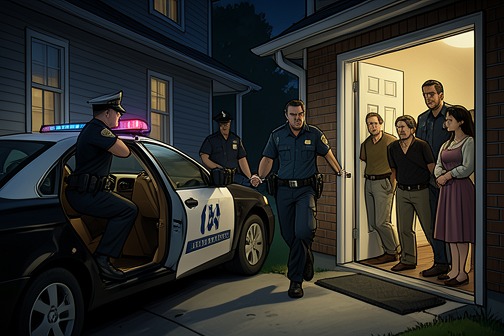
[Callum McGregor](entity:character-recall-character-callum-mcgregor-50a89b03e1a0)’s arrest is a turning point in which the state’s power enters the McGregor family home before the family knows what it is accused of. The nighttime raid leaves Callum in custody, his family separated and frightened, and the reasons for the police action unclear; its aftermath exposes how identification systems and official procedures operate within a society already marked by hostility toward [Noughts](entity:concept-recall-concept-noughts-1aaaa6ffdea4).
## Background and Institutional Climate
The arrest takes place against a wider pattern of discrimination, not in isolation from it. At Heathcroft, Nought students are admitted into a hostile crowd’s chants of “NO BLANKERS IN OUR SCHOOL. NO BLANKERS IN OUR SCHOOL.” Police stand between the students and the Cross crowd, but the scene establishes that formal protection does not necessarily prevent abuse. Later, a television report describes the admission of Noughts to the school as having met with “some hostility,” while omitting the police officers’ failure to stop the crowd from reaching and assaulting the students. The contrast between the events and their public presentation suggests how institutional accounts can minimize the treatment Noughts receive.
That inequity is also apparent in school authority. When [Mrs Paxton](entity:character-recall-character-mrs-paxton-a89c7b5539e1) warns that Nought pupils are being continually targeted and that retaliation may follow, Mr Costa responds that if they are finding school difficult, they can go elsewhere. The dismissal makes the school’s unequal welcome part of the larger setting for [Callum’s arrest](entity:action-recall-action-callum-s-arrest-2d2a3b81aec7): authority figures can frame exclusion as the Noughts’ problem rather than address the hostility directed at them.
## The Nighttime Raid
The raid begins without warning. Callum is woken by the front door being broken in and by people rushing through the house. In the confusion, he calls for [Jude](entity:character-recall-character-jude-c859762b9a2d), fearing that his brother may still be asleep, before realizing that the substance filling the rooms is tear gas rather than smoke. Police order him to the ground, restrain him, and take him outside to a car. His account emphasizes how little he can understand at the time: he is taken away without being told why.
The arrest does not resolve the immediate uncertainty for Callum’s family. His mother cries as he is put into the car, while his father is also taken into police custody. When Callum’s mother later asks about her husband, an officer tells her that he is being held and will be formally charged. She challenges the detention, insisting that her husband has done nothing wrong, but receives no explanation of the charge in that exchange. The separation of family members thus becomes part of the arrest’s consequence before the accusation is even clear.
## Identification and Suspicion
The family later learns that police suspicion involves an empty drinks can found near the [Dundale Shopping Centre bombing](entity:event-recall-event-dundale-shopping-centre-188a2d52e782). Callum’s mother says that investigators claim the can bears Jude’s fingerprints and that they matched them against the print on his ID card. She calls the allegation a lie. This explanation shifts the immediate focus from Callum’s own arrest to the accusation drawing the police toward the McGregor household, while showing the family’s distrust of the evidence and the process used to identify it.
The ID card is not an incidental detail. Earlier, at the hospital, staff require the family’s identity cards before providing medical care, citing a new government rule that patient IDs must be checked and registered. Later, the claim about the can depends on a fingerprint associated with an ID card. Together, these episodes connect routine identity administration to policing: information gathered or verified through ordinary official systems can become relevant to a criminal investigation, even as the family disputes what the resulting identification proves.
## From Arrest to Public Judgment
The arrest’s effects extend beyond the night of the raid. Sephy’s mother warns her that her association with Callum and his family will drag the Hadley name into court, newspapers, and public scandal. Her response treats the McGregors’ legal crisis as a reputational danger to the Hadleys, revealing the social distance that persists even where personal ties cross the Nought–Cross divide.
The subsequent proceedings turn evidence into public spectacle. At Callum’s trial, the prosecution presents a video assembled from closed-circuit footage of the [Dundale Shopping Centre](entity:location-recall-location-dundale-shopping-cen-fa026bd7f99a), while Callum’s father silently signals him not to respond. The arrest therefore stands at the start of a chain in which surveillance, disputed identification, courtroom evidence, and family consequences converge. The evidence here does not establish that Callum’s arrest itself proves the accusation against the family; rather, it presents an apprehension carried out before Callum understands the reason, followed by a process whose evidence the McGregors distrust.
## Narrative Significance
Callum’s account makes the arrest’s defining feature its lack of explanation. The scene moves from sleep to forced removal, but not from uncertainty to understanding: after being taken away, he still does not know why. That gap gives the event its force and links the family’s immediate fear to the wider mechanisms that follow—identity registration, fingerprint comparison, detention, and prosecution.
The novel places this private crisis alongside public and institutional forms of exclusion. At school, hostility is minimized in the news; at the hospital, identity checks are presented as administrative procedure; in the criminal investigation, an ID-linked fingerprint claim becomes a basis for suspicion. The arrest thus marks a transition from racial hostility experienced in public spaces to state action inside the home, while the later proceedings show how that action can acquire the appearance of formal evidence and legal process.
Event 12
Ryan McGregor's confession
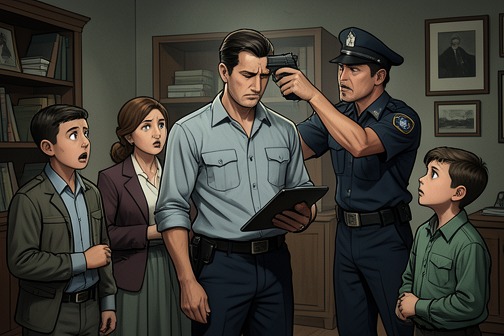
[Ryan McGregor](entity:character-recall-character-ryan-mcgregor-4cbbf931afd1)’s confession is a false admission to the [Dundale Shopping Centre bombing](entity:event-recall-event-dundale-shopping-centre-188a2d52e782), made under threat to keep the authorities from imprisoning his wife and sons. Its significance lies in the terrible exchange it sets in motion: Ryan accepts responsibility for a crime he denies committing so that [Jude](entity:character-recall-character-jude-c859762b9a2d) will not die, but the confession gives the state the evidence it needs to prosecute and condemn Ryan instead.
## Background and Coercion
The confession emerges from the aftermath of the bombing and the police’s pursuit of Jude. Ryan tells his family that the authorities said they had Jude and proof that he was the bomber, then made clear that someone had to take responsibility for the Dundale attack. They left him to choose who would bear the blame. Ryan says he confessed because the police threatened to imprison Meggie and Callum as well for conspiracy, making his own life the price of protecting his family.
The decision is not presented as a genuine admission of guilt. When Meggie asks whether he planted the bomb that killed people, Ryan answers no. He distinguishes the confession he signed from the truth he says he told police, insisting that his family’s safety, rather than responsibility for the bombing, compelled him to claim the charges.
## The Evidence and Ryan’s Account
The confession acquires the appearance of legal certainty through both procedure and physical evidence. Detective Inspector Santiago tells the family that Ryan confessed as soon as he was told whose fingerprints had been found. His dictation and signature were videotaped, and the police maintain that the recording shows no duress. Ryan’s account of intimidation is thus set against the official claim that the confession was voluntary.
The fingerprints belong to Jude: two were found on a cola-can fragment in the bin where the bomb went off. Ryan explains that he brought the cola from home to avoid being seen buying one in a shop. Jude had apparently handled the can and returned it without Ryan noticing. Ryan also says that he kept the necessary equipment for the casing at home and that Jude must have touched it out of curiosity. He presents these contacts as innocent explanations for traces that otherwise appear to connect Jude to the attack.
Ryan makes his defense emphatic and public, raising his voice and insisting that Jude had nothing to do with the bombing. He calls himself guilty and nobody else. The insistence cannot erase the physical evidence, but it reveals the confession’s purpose: Ryan is trying to take Jude’s place in the case, not to describe his own actions as bomber.
## From Confession to Prosecution
The recorded confession is quickly converted into a public account of guilt. A news report identifies Ryan by his full name and address, says he has been charged with political terrorism and seven counts of murder, and describes the case as a formality because he has confessed. It also reports that Meggie and their sons are in hiding. The speed of this announcement contrasts with the uncertainty and coercion the family has just described: the official story is already settled while Ryan’s reasons for confessing remain private.
At trial, Ryan pleads guilty to the charge of political terrorism. Callum cries out for him not to do so, but [Judge Anderson](entity:character-recall-character-judge-anderson-f6952ebcfeea) threatens to have the public gallery cleared if there are further outbursts. Ryan meets Callum’s eyes only briefly; Callum remembers his father’s split lip, bruised cheek, and black eye, and sees sadness rather than condemnation. The plea therefore carries consequences beyond the courtroom formality described in the news: it leaves Ryan’s family watching him accept a sentence built on the confession.
## Consequences and Significance
Ryan’s chosen lie protects Jude from immediate execution. He tells Meggie to make sure Jude stays lost so the police will not find him and says that, at least, his confession means Jude will not die. Protection is not absolution: Ryan’s action conceals Jude from the authorities while transferring the full legal danger to himself.
The consequences reach beyond the trial. At [Hewmett Prison](entity:location-recall-location-hewmett-prison-e77fa57b9d9d), [Crosses](entity:concept-recall-concept-crosses-47abf27d378b) are seated while [Noughts](entity:concept-recall-concept-noughts-1aaaa6ffdea4) stand before the scaffold, and Callum recognizes his father among those brought to be executed. The execution announcement names Ryan as convicted of seven murders and political terrorism after his appeal has been denied. The false confession thus becomes the link between a family’s attempt to survive police threats and the state’s public, irreversible punishment of Ryan.
The episode also belongs to a wider pattern in which institutions turn the Nought family’s vulnerability into procedure. Earlier, a school crowd chants against Nought students while police struggle to reach the entrance; on television, the hostility is softened to “some hostility.” At school, Mr Costa suggests that Noughts who find conditions difficult should go elsewhere, despite [Mrs Paxton](entity:character-recall-character-mrs-paxton-a89c7b5539e1)’s warning that they are being constantly targeted. Later, even hospital care is preceded by a government requirement to check and register patients’ identity cards. Against these ordinary and official forms of exclusion, Ryan’s taped confession demonstrates how a process presented as lawful can still conceal coercion and make a Nought father’s sacrifice look like proof of guilt.
Ryan’s confession is therefore both an act of familial protection and a mechanism of injustice. He claims the bombing to keep Meggie and Callum from prison and to prevent Jude’s death; the authorities record his words as voluntary, the news treats the case as settled, and the court carries the claim through to execution. What Ryan means as a shield for his sons becomes the state’s instrument for condemning him.
Event 13
The trial of Ryan McGregor
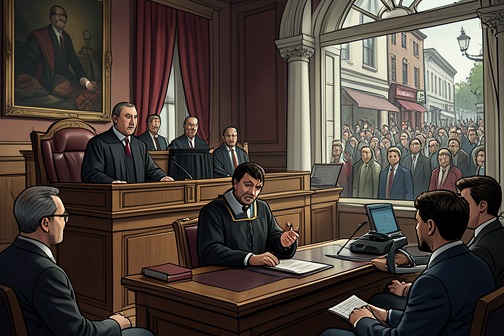
[The trial of Ryan McGregor](entity:event-recall-event-the-trial-of-ryan-mcgre-6d37d8ce20e3) is a public prosecution that places the charge of political terrorism and seven murder counts against a father before a jury and a family forced to watch. Ryan’s not-guilty pleas do not prevent conviction, and the sentence culminates in his execution at [Hewmett Prison](entity:location-recall-location-hewmett-prison-e77fa57b9d9d). Told through Callum’s and Sephy’s alternating first-person perspectives, the trial exposes the distance between courtroom procedure and the characters’ sense of justice, while making the consequences of the verdict visible in the lives of Ryan’s family and the wider Nought–Cross divide.
## Causes and Background
The trial follows the [Dundale Shopping Centre bombing](entity:event-recall-event-dundale-shopping-centre-188a2d52e782) and the deaths attributed to it. When [Jude](entity:character-recall-character-jude-c859762b9a2d) returns home, he explains that his cell had been ordered to carry out the bombing and that some members had helped set it up the previous night. He says they were promised a warning call an hour before it went off so that everyone could be evacuated. His account leaves him bewildered when his father asks about the warning; their mother responds that people have been killed. Ryan’s later prosecution therefore unfolds amid a family’s conflicting explanations of the bombing and the consequences of political violence.
The trial is also framed by unequal treatment beyond the courtroom. At Heathcroft, a crowd gathers against the newly admitted Nought students, chanting against their presence while police try to move the crowd and reach the entrance. Later, Sephy watches a television report on the school and recognizes that it omits the police allowing [Crosses](entity:concept-recall-concept-crosses-47abf27d378b) to harass the Nought students, as well as the spit covering the back of her jacket. The report describes the hostility in softened terms. These scenes establish a wider context in which official and public accounts of events can obscure what [Noughts](entity:concept-recall-concept-noughts-1aaaa6ffdea4) experience directly.
Institutional attitudes appear in the school administration as well. Sephy overhears [Mrs Paxton](entity:character-recall-character-mrs-paxton-a89c7b5539e1) warning that the Nought students are constantly being picked on and that one of them may retaliate. Mr Costa answers that if they are finding it difficult, they can go elsewhere. The exchange does not determine the trial’s outcome, but it shows how a supposed response to conflict can place the burden on the excluded group rather than those targeting them. The legal proceedings later become another institutional setting in which Sephy and Callum doubt that formal procedure guarantees equal justice.
## Pleas in Court
Callum watches from the packed public gallery as the judge instructs the jury about the case. His father is far below him, and Callum sees the bruising on his face, having seen him only once since the police entered their lives. When the clerk asks Ryan how he pleads to political terrorism, Callum shouts for his father not to do it. [Judge Anderson](entity:character-recall-character-judge-anderson-f6952ebcfeea) threatens to clear the public gallery if there are further outbursts. Callum knows his protest may make matters worse, but cannot remain silent as the charge is put to his father.
Ryan looks toward Callum and his mother, then answers, “Not guilty!” The clerk proceeds to the murder charge concerning Aysha Pilling and then reads the separate charges. Ryan pleads not guilty to each. As the clerk reaches the seventh murder charge, the courtroom becomes louder; Ryan repeats his plea strongly enough to be heard over the uproar. The judge orders the gallery cleared. For Callum, Ryan’s refusal to plead guilty is a moment of happiness within a proceeding he regards as a farce: the family’s emotional certainty and the court’s authority are already pulling in opposite directions.
Sephy’s family sees the trial through another register of consequence. Her mother warns that the family name will be dragged through court, newspapers, and public attention because Sephy has been associated with Callum and his family. When Sephy objects that the situation is hardly her fault, her mother answers with a proverb about lying down with dogs and getting fleas. Her response treats the connection as a source of contamination and scandal, sharpening the racial and familial pressure surrounding the proceedings rather than engaging with Ryan’s plea.
## Verdict and Sentence
At the verdict hearing, the foreman confirms that the jury has reached an agreed decision. Sephy cannot make out the first answer and is unsure whether the foreman has spoken at all. When the clerk asks whether Ryan is guilty of murdering Aysha Pilling, Sephy hears the verdict. The narrative does not reproduce the word she hears in that moment, but the later announcement at Hewmett Prison confirms that Ryan has been found guilty of seven counts of murder and political terrorism. The delay between the question and Sephy’s comprehension makes the verdict arrive first as suspense, then as an irreversible fact.
Ryan’s appeal is denied. At Hewmett Prison, an official announces that the execution will be carried out by hanging. Sephy has arrived with her family without understanding why they are there; she realizes the purpose of the visit only when the execution is formally announced. Across the courtyard, Noughts stand while the Crosses sit in the audience. Sephy catches Callum’s eye and is shocked to see him there. The public ritual places the family’s private loss within a divided crowd, turning the court’s sentence into a visible social event.
## Families, Witnesses, and Consequences
For Callum, the trial is not an abstract legal dispute. He sees his father’s battered face, hears him reject every charge, and risks the judge’s anger by trying to interrupt the plea. His mother restrains him in the gallery, while Ryan’s look toward them gives the family a brief point of contact inside the proceeding. The court can remove the spectators, but it cannot make the verdict emotionally distant from those who remain outside its authority.
For Sephy, the case brings the McGregor family’s fate into conflict with her own family’s concern for status and reputation. Her mother’s warning turns association with Callum into a danger to the Hadleys’ public standing. At the prison, however, Sephy is made a witness to the outcome that this distance cannot undo. Ryan’s conviction and execution connect the courtroom’s decision to the family relationships and racial divisions that the novel follows beyond the trial itself.
## Narrative and Significance
The trial is presented through alternating character perspectives rather than an impersonal account of legal evidence. Callum’s view emphasizes his father’s plea and the strain of watching from the gallery; Sephy’s perspective makes the verdict difficult to hear and the execution initially difficult to understand. Neither perspective supplies the jury’s reasoning. Instead, the narrative concentrates on what the proceedings reveal to those who must live with their result: the gap between official authority and personal conviction, and the fear that institutions shaped by racial hierarchy may not deliver justice equally.
The sequence moves from accusation, through Ryan’s repeated not-guilty pleas, to a verdict confirmed by the later prison announcement and an execution that the appeal fails to prevent. Its significance lies not only in Ryan’s sentence, but in the way the trial makes a family’s loss public and intensifies the novel’s central conflict over Nought–Cross inequality. The courtroom’s verdict is final in law; for Callum and Sephy, it becomes a defining rupture whose consequences continue after the proceedings end.
Event 14
Ryan McGregor's execution reprieve
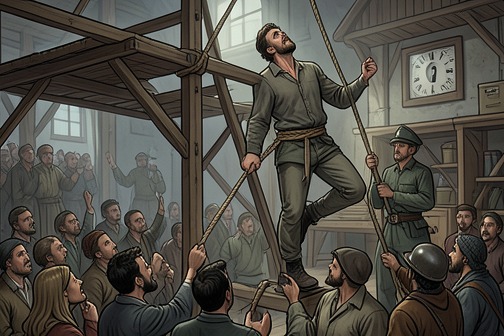
[Ryan McGregor's execution reprieve](entity:event-recall-event-ryan-mcgregor-s-executi-efa9460b5ccd) halts his hanging at [Hewmett Prison](entity:location-recall-location-hewmett-prison-e77fa57b9d9d) at the last moment, changing his sentence from death to life imprisonment. Narrated by his son Callum, the scene turns on a sharp reversal: the execution is stopped, but Ryan is not released, and the reprieve that preserves his life leaves the gathered family and supporters confronting the continuing punishment and the injustice they see in the proceedings.
## Causes and Background
Ryan has been found guilty and brought from the prison to the scaffold for execution. His lawyer, [Kelani Adams](entity:character-recall-character-kelani-adams-2888aae8f6db), has concentrated on his appeal, setting aside her other cases and telling Ryan's wife and son that she would not rest until he was free. As the family waits for the execution, Callum recalls that Kelani is still making urgent phone calls. The reprieve thus arrives against a sustained legal effort, although the scene does not identify what directly caused the decision or say that new evidence established Ryan's innocence.
Ryan's father calls out, “Long live the Liberation Militia …” as the countdown continues. The execution's imminent completion is interrupted when a voice from beneath the scaffold cries, “WAIT! WAIT!” A prison official identifies the caller as the governor, and the announcement suspends the action before the hanging takes place. The interruption is sudden; the people watching are given no immediate explanation of what the governor's intervention will mean.
## The Reprieve Announced
A Cross moves from behind the scaffold's wooden lattice and signals to the guard standing with Ryan. The governor then climbs the scaffold steps, and the guard removes the hood from Ryan's head. Ryan appears disoriented; the governor speaks to him and has to repeat his words before asking whether Ryan understands. Ryan shakes his head, then nods after the governor places a hand on his shoulder. These gestures delay the public announcement and keep Callum, watching from below, uncertain about what has happened.
Governor Giustini raises his hands for silence and tells the assembled audience that Ryan has received a reprieve and that his sentence has been commuted to life imprisonment. He makes the outcome explicit: there will be no hanging that day. The decision is not a pardon or a release. Ryan is spared execution, but the announced replacement sentence keeps him imprisoned for life.
## Immediate Reactions and Consequences
The announcement leaves Ryan's knees unsteady, and a prison officer catches him before he falls. The crowd then erupts. Callum and the people around him surge towards the scaffold, wanting to reach Ryan and take him away, but tall metal barriers hold them back. Callum shouts for his father until his voice is lost in the noise. The governor and Ryan are hurried down the scaffold steps and back into the prison.
The reprieve therefore changes the immediate prospect of death without resolving the family's separation. The crowd cannot follow Ryan inside, and Callum's effort to reach him ends at the barriers. The gathering's anger is directed not only at the outcome but at the continued confinement: a life has been saved while the prisoner remains beyond the family's reach.
## Unequal Access and Narrative Significance
Callum's account sets the crowd's reaction beside the unequal arrangements for watching the execution. The supporters are penned behind barriers and later led through a side gate, where each person is scanned and searched. Cross spectators, by contrast, have been able to drive in and sit down; as the crowd is moved away, Callum sees them leaving in a hurry. He cannot find a particular woman among them and questions whether she had watched for entertainment, but her identity and presence are not established in the scene.
The reprieve's emotional turn is thus inseparable from the setting in which it is announced. The possibility that Ryan might be freed briefly occupies Callum's thoughts, but the governor confirms only a commutation, and the prison takes Ryan back inside. The crowd's thwarted attempt to reach him, together with the contrast in how Nought and Cross spectators are treated, makes the event both a reprieve from execution and a continuation of the divisions and confinement surrounding Ryan's case.
Event 15
Dundale Shopping Centre爆炸案
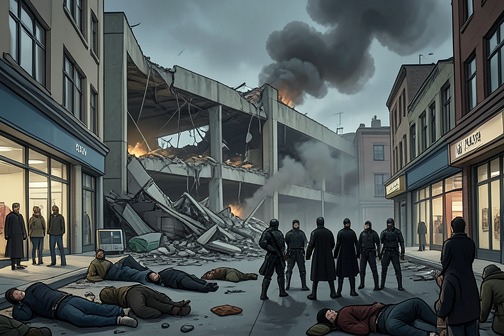
The [Dundale Shopping Centre bombing](entity:event-recall-event-dundale-shopping-centre-188a2d52e782) becomes a turning point in the conflict between [Noughts](entity:concept-recall-concept-noughts-1aaaa6ffdea4) and [Crosses](entity:concept-recall-concept-crosses-47abf27d378b): it kills seven people, leads to [Ryan McGregor](entity:character-recall-character-ryan-mcgregor-4cbbf931afd1)’s conviction for political terrorism, and sets in motion consequences that reach far beyond the explosion itself. The novel presents the bombing not only as mass violence but as a contested account—one in which responsibility, warning, and justice are entangled with racial power.
## Background and Competing Accounts
The bombing is linked to the Liberation Militia, whose cell ordered the operation. When [Jude](entity:character-recall-character-jude-c859762b9a2d) explains what happened to his parents, he says that some members of the cell helped set it up the previous night and that they had been told a warning would be phoned through an hour before the explosion. He insists that the warning was meant to allow everyone to evacuate in time. His account does not undo the deaths: his mother responds that people have been killed, while Jude turns to his father, bewildered about what went wrong.
The promise of a warning remains central to the difference between what Jude says his cell was told and the actual outcome. The evidence establishes that the operation killed seven people and that Jude believed an evacuation warning would be given; it does not establish why the warning failed to prevent the deaths. That unresolved gap makes the bombing both a political crime and a rupture within the McGregor family.
## Public Account and Institutional Climate
The bombing takes place against a wider climate of hostility toward Noughts. At Heathcroft, a crowd gathers outside the school and chants against Nought students’ admission. The protest is met with a police presence, but Callum later describes how officers who were supposed to guard the students allowed the crowd to reach them. Television coverage, in his account, leaves out that treatment and minimizes the hostility as “some hostility.” His criticism places the bombing’s public aftermath in a society where accounts of racial conflict can be softened or selectively shown.
Other institutional encounters reinforce that pattern. At Heathcroft, Mr Costa suggests that Nought students who find school difficult should go elsewhere, while [Mrs Paxton](entity:character-recall-character-mrs-paxton-a89c7b5539e1) warns that they are being repeatedly targeted and that retaliation may follow. Later, a nurse tells the McGregor family that new government rules require patients’ identity cards to be checked and registered before medical care can be administered. These scenes do not explain the bombing, but they situate it within a story where education, news, healthcare, and policing all shape Noughts’ exposure to exclusion and state authority.
## Trial, Conviction, and the Death Sentence
Ryan McGregor is prosecuted for political terrorism and the seven murders. At the trial, Callum cries out for his father not to plead guilty, even as he recognizes that the interruption may make matters worse. [Judge Anderson](entity:character-recall-character-judge-anderson-f6952ebcfeea) threatens to clear the public gallery if there are further outbursts. Ryan looks toward Callum, but quickly looks away; Callum remembers his father’s bruised face and the sadness in his expression. The scene connects the courtroom’s formal procedure to the family’s distress, while making clear that Ryan’s case is not merely an abstract legal proceeding for his son.
The consequences extend into Sephy’s family as well. Her mother blames her association with Callum and his family for bringing their names into court and the newspapers, then tells Sephy that people who lie down with dogs get fleas. Her response turns the trial into a further point of conflict between Sephy and her mother, showing how the bombing’s reach crosses family and racial boundaries even as it sharpens suspicion and blame.
## Execution Reprieve and Prison Death
Ryan is sentenced to hang after being found guilty of seven counts of murder and political terrorism. At [Hewmett Prison](entity:location-recall-location-hewmett-prison-e77fa57b9d9d), Sephy arrives with the Crosses seated at the front while Noughts stand around the courtyard. She sees Callum among them, then hears the sentence announced and realizes that Ryan is to be executed. The scene makes the punishment public: the gathered Noughts and Crosses occupy sharply contrasting positions as Ryan’s death is presented as a state proceeding witnessed by both communities.
Ryan’s sentence is later changed at the last moment. A news report says that the Home Office has granted him a reprieve, with his hanging due four days earlier, but that he has died while attempting to escape Hewmett Prison. He is electrocuted as he tries to scale the prison’s electrified fence, and officials announce an immediate inquiry. The reprieve therefore does not save him; the announced outcome shifts from execution to death during an escape attempt, leaving the family devastated and the circumstances subject to investigation.
## Consequences and Significance
The bombing’s consequences accumulate across the novel: seven deaths, Ryan’s prosecution and conviction, a death sentence, a reprieve that comes too late to prevent his prison death, and the McGregor family’s grief. The account of a promised warning, followed by the deaths and the legal proceedings, keeps the distinction between the operation’s intended precautions and its actual consequences in view without making the losses disappear.
The event also reveals how violence and racial hierarchy reinforce each other. The novel places the bombing alongside discrimination at school, omissions in news coverage, identity checks in healthcare, and the public performance of Ryan’s sentence. Those connections do not make the bombing less consequential or absolve those involved; instead, they show how private responsibility and institutional injustice coexist in a society already organized by unequal power. Ryan’s death, rather than resolving that conflict, deepens the grief and division that follow it.
Event 16
Ryan McGregor在Hewmett监狱死亡
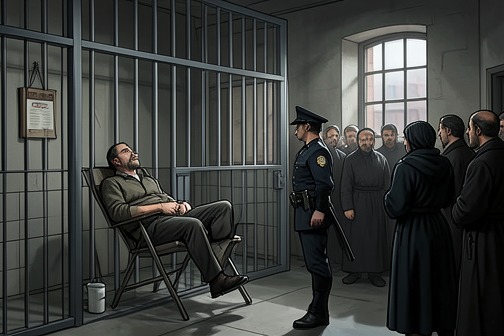
[Ryan McGregor](entity:character-recall-character-ryan-mcgregor-4cbbf931afd1)’s death at [Hewmett Prison](entity:location-recall-location-hewmett-prison-e77fa57b9d9d) turns a reprieve from execution into a fatal escape attempt, leaving Callum convinced that the authorities’ account conceals the truth. The disputed circumstances deepen the family’s grief and give institutional injustice a lasting place in Callum’s understanding of his father’s death.
## Execution and Reprieve
Ryan had been convicted in connection with the [Dundale Shopping Centre bombing](entity:event-recall-event-dundale-shopping-centre-188a2d52e782) and sentenced to hang. At the prison, [Persephone Hadley](entity:character-recall-character-persephone-hadley-eb8440fea67a) sees Callum among the noughts assembled to witness Ryan’s execution. The formal announcement identifies Ryan as having been found guilty of seven counts of murder and political terrorism; only then does Persephone understand why she and the other [Crosses](entity:concept-recall-concept-crosses-47abf27d378b) have been brought into the courtyard. Ryan is led out, and his sentence is presented as imminent.
The execution does not take place as announced. Four days after Ryan was due to hang, the Home Office grants a last-minute reprieve. That reversal changes the immediate prospect of his death but does not restore his freedom: he remains imprisoned at Hewmett, where he later dies during an attempted escape.
## The Official Account
A news report states that Ryan was killed while trying to scale Hewmett Prison’s electrified perimeter fence. It describes his death as electrocuting while attempting to escape and notes that officials have launched an immediate enquiry. The report also says that his family are devastated and unavailable for comment. The public account supplies a concrete sequence—reprieve, escape attempt, death—but leaves the circumstances and meaning of the attempt unexplored.
The report’s language is set against the execution that had been expected only days earlier. Ryan had been scheduled to die by hanging; instead, he dies in prison after the reprieve. The change in method does not end his confinement or answer what happened to him. It makes the supposed reprieve a bitter reversal rather than a release.
## Callum’s Response and the Disputed Meaning
Callum experiences his father’s death as murder, not suicide, and says that every nought knows the official interpretation is false. His certainty is presented alongside, not resolved by, the news report: the text gives the authorities’ account of an escape attempt, then Callum’s conviction that the death cannot be understood on those terms. It does not establish further details about how Ryan came to the fence or what he intended there.
The loss remains immediate for Callum months later. He says that something inside him died with his father, and that thoughts of Ryan still hurt whenever they return. He wonders what Ryan was thinking at the fence and what his final thought might have been, recognizing that he will never know. The unanswered question becomes part of the grief itself.
## Family and Narrative Consequences
After the report, Persephone prays for Callum and his family, asking that they be left alone and reflecting that people may blame hatred on God or the devil rather than take responsibility for it themselves. Her response links Ryan’s death to the broader racial hostility surrounding the family without claiming knowledge of the prison events beyond what has been reported.
For Callum, the death renews and sharpens his hatred of the Crosses. His visits to the beach do not restore the past, and his thoughts repeatedly return to Ryan and the fence. The movement from a public reprieve to a death that Callum regards as state-caused violence leaves the central discrepancy unresolved: officials call it an escape attempt, while Callum and other noughts reject the authorities’ account. That unresolved divide shapes the loss’s continuing significance.
Event 17
Callum加入解放民兵组织
Callum’s recruitment into the Liberation Militia is a decisive turn from bereaved, directionless teenager to committed member of a clandestine armed organization. [Jude](entity:character-recall-character-jude-c859762b9a2d)’s invitation offers Callum purpose and a place within the group; the years that follow show the cost of that belonging, as he rises through its ranks and uses its resources to pursue revenge.
## Background and Recruitment
After Ryan’s execution, Callum is left grieving his father and without a clear direction. At sixteen and a half, he describes himself as having nothing to do and nowhere to go, while his mother remains unreachable in her grief. When Jude unexpectedly reappears and asks whether Callum is “in or out,” the question is more than an offer to join: it is Callum’s chance to enter the Liberation Militia, and he understands that refusing may mean never being asked again.
Jude presents membership as a chance to make a difference. Callum responds that a calmness and purpose he has not felt for a long time come over him, then accepts. Jude tells him to go home, pack his bags, and make his peace with their mother; Callum will be contacted the next day and will not see her or the people they know for a while. Jude welcomes him to the “lifeboat party,” but adds that he hopes he can trust him. The warmth of the welcome and its test of loyalty arrive together.
## Life Inside the Organization
Callum later recalls that Ryan had warned him that once the Liberation Militia had someone, it never let them go. He starts as little more than a tea boy, then follows orders as a grunt in a cell of six men and three women. He advances to private and eventually to sergeant, joining a new cell; he is proud to hold that rank at nineteen. This progression gives concrete form to the purpose he found in joining, while placing him within a tightly organized chain of command.
The organization’s secrecy and discipline shape both its operations and its members’ lives. When Callum and his fellow militants plan to abduct Sephy, he describes a cabin in a woodland clearing known only to a select few on a need-to-know basis. Guards are assigned at all times, one at the front and one at the back, and the clearing leaves anyone approaching without cover. Jude and [Pete](entity:character-recall-character-pete-20a13c365688) have planned the operation for more than two weeks and obtained the General’s permission; the General’s second-in-command is expected after it happens. The episode shows the scale of organization Callum has entered, as well as the violence and coercion its planning serves.
## Revenge and the Militia’s Aims
As his rank and access to resources grow, Callum pursues personal revenge against Dionne Fernandez, Lola Jordan, and Joanne Longshadow, the Heathcroft students who beat Sephy for sitting with him. He uses his contacts to learn where they live and to gather information about their home lives, family circumstances, likes, and dislikes. He acts against them one by one: Lola first, Joanne next, and Dionne last. He takes particular care to make Dionne suffer as she had made Sephy suffer.
Callum recognizes that revenge changes him. He says he loses more of himself with each act and contrasts the person he has become with the [Callum Ryan McGregor](entity:character-recall-character-callum-ryan-mcgrego-46ffb39d6bb5) who once loved sitting on the beach and watching the sun go down. His account makes recruitment a turning point, not a clean passage from vulnerability to empowerment: the Militia supplies connections, rank, and means of action, while his chosen retaliation deepens the loss he is trying to answer.
The organization’s broader actions place that personal trajectory within a political campaign conducted through violence and leverage. After the Dundale bombing, Callum realizes that the Liberation Militia is planning something at the shopping centre and that Jude knows about it; fearing for Sephy, he recognizes she is there. Later, the kidnapping plan pairs ransom money to fund future Militia activity with a demand that five imprisoned members be released before [Kamal Hadley](entity:character-recall-character-kamal-hadley-0c49a552686e) can see his daughter again. Three of the five are key members, although authorities believe they are lower-ranking figures. The operation’s careful communication plan—relay calls from different locations and separate instructions—shows how secrecy serves the group’s strategic aims.
## Consequences and Significance
Callum’s recruitment also places him under suspicion. During questioning, officers ask about his brother’s involvement and which Militia cell Callum belongs to; exhausted, he denies that his brother is a member. His earlier decision to leave home and go without contact with his family thus opens into a life organized around cells, orders, and concealment.
The episode links the appeal of collective purpose to the costs of militant action. Callum joins while grieving and isolated, and the Militia gives him a rank, a network, and the capacity to strike back against people who harmed Sephy. Yet its operations include the Dundale plot and Sephy’s abduction, while Callum’s own revenge makes him feel that the beach-loving self he remembers no longer exists. Recruitment brings belonging and agency, but it also draws him into a cycle of secrecy and violence that reshapes his identity.
Event 18
Sephy遭绑架并被扣为人质
Sephy’s kidnapping is a calculated hostage-taking that transforms a private reunion with Callum into an act of violence. Pursued on a dark shore, Sephy is caught and beaten; the abductors then conceal her, intending to use [Kamal Hadley](entity:character-recall-character-kamal-hadley-0c49a552686e)’s daughter to compel him to meet their demands.
## The ambush on the shore
Callum steps forward and kisses Sephy, but the brief, cold kiss offers no comfort: four noughts are approaching behind him. Sephy reads the shock on her own face and the resignation in Callum’s, then runs. She does not try to make out the pursuers’ shouts. In the darkness, she realizes she has run kilometres from anywhere and away from the cliff steps; when she turns back toward the sea, one of the men grabs her before she can take three steps.
## Sephy is overpowered
The assault is described through the damage done to Sephy’s body. A punch to her stomach leaves her doubled over and retching onto the sand. A man clamps her arms around her waist, shakes her, and drags her backwards by her hands when she tries to slip free. Her bare heels and body scrape against sharp rocks and stones as he hauls her over a boulder; pain leaves her whimpering and struggling to stay conscious. One attacker says the assault is for his sister, making the violence a stated act of revenge as well as part of the abduction.
## From assault to hostage-taking
After the attack, Callum’s companions celebrate having seized [Persephone Hadley](entity:character-recall-character-persephone-hadley-eb8440fea67a), Kamal Hadley’s daughter. They have bundled the unconscious Sephy into the boot of their car and hidden her in a remote place where, they believe, nobody will find her—or them. Their purpose is explicit: Sephy will not see daylight again unless Kamal agrees to their demands. The kidnapping thus turns her family connection into leverage, while the captors’ jubilation contrasts sharply with the violence and helplessness that brought her into their hands.
## A private encounter becomes political leverage
The kidnapping’s stakes arise from the identity of the captive as much as from the force used to take her. Callum’s companions identify her as Persephone Hadley, the daughter of Kamal Hadley, and explicitly intend to hold her until Kamal agrees to their demands. Sephy is no longer simply a person caught in an ambush: the captors make her family connection the means of coercion, turning an intimate reunion into a hostage crisis. Their confidence that the remote hiding place will keep both her and themselves undiscovered only sharpens the contrast between their triumph and the helplessness of their unconscious captive.
## The hostage’s political meaning
Sephy’s abduction makes visible how the Nought–Cross hierarchy turns a personal relationship into political leverage. The captors’ plan depends on her identity as Kamal Hadley’s daughter: they intend to keep her hidden until he agrees to their demands. That coercion unfolds against a public world already structured by hostility and unequal power. At Heathcroft, a Cross crowd chants against Nought students while police struggle to move them toward the school entrance; later, a television report reduces assaults on the students to “some hostility,” omitting both police inaction and the spit covering Callum’s jacket. At school, Mr Costa suggests the [Noughts](entity:concept-recall-concept-noughts-1aaaa6ffdea4) should go elsewhere rather than confront the persecution they face. These episodes do not explain every captor’s motive, but they place the kidnapping within a society where institutional responses and public accounts repeatedly minimize Noughts’ mistreatment.
The surrounding institutions sharpen that contrast. A hospital nurse tells Meggie that government rules require patients’ identity cards to be checked and registered before care can be administered. In another family confrontation, Sephy’s mother warns that association with Callum and his family will bring disgrace, then blames Sephy for the trouble through a proverb about lying down with dogs. The language of regulation, respectability, and blame frames the risks of crossing the social divide; on the shore, the consequences become physical, as Sephy is struck, dragged over rocks, and hidden as a bargaining instrument.
The kidnapping also sits beside the state’s use of spectacular punishment. At [Hewmett Prison](entity:location-recall-location-hewmett-prison-e77fa57b9d9d), Sephy arrives among Cross spectators and sees Callum again, standing among the Noughts who have gathered for his father Ryan’s execution. Ryan is announced as convicted of seven murders and political terrorism, and the sentence is carried out by hanging. That execution is not the kidnapping’s stated cause, but the juxtaposition gives the hostage-taking a wider political setting: public authority exposes a Nought family to punishment while the militants turn a Cross politician’s daughter into private leverage. The episode’s central reversal is stark—Sephy, accustomed to the protection attached to her family name, is rendered helpless by the same name’s value to her captors.
Event 19
人质危机迫使Kamal Hadley退出公职

[Kamal Hadley](entity:character-recall-character-kamal-hadley-0c49a552686e)’s withdrawal from public office is a concession forced by the Liberation Militia’s kidnapping of his daughter, Sephy. Announced on television at seven o’clock, it signals that the hostage crisis has reached the heart of government—but does not end the captors’ leverage: they plan to demand ransom and the release of five militia members before Sephy can see her father again.
## Background and Leverage
The announcement follows the militia’s abduction of Sephy and its demands to Kamal. The account makes the connection explicit: the group has instructed him to appear publicly, and its members gather to watch the broadcast. The public statement is therefore not a voluntary political departure on his own terms, but a response staged under pressure from those holding his daughter.
The episode sits within a society already marked by conflict between [Noughts](entity:concept-recall-concept-noughts-1aaaa6ffdea4) and [Crosses](entity:concept-recall-concept-crosses-47abf27d378b). At Heathcroft, a crowd had gathered to chant against the admission of Nought students, while the school’s headmaster suggested that Noughts who found the hostility difficult should go elsewhere. The news later softened the school violence as “some hostility,” omitting the police failure to protect students from being poked, pinched, and punched. These moments establish a broader political environment in which institutional power and public language conceal or normalize unequal treatment; the hostage crisis turns that conflict into direct pressure on a senior Cross politician.
## The Televised Withdrawal
At seven precisely, Kamal appears in a newsflash and announces that he will be “temporarily withdrawing from public office for personal family reasons.” He declines to elaborate and leaves the press office immediately. His carefully limited explanation offers the public no account of the coercion behind it, even as the captors watching from their hideout understand the statement as compliance.
[Jude](entity:character-recall-character-jude-c859762b9a2d) celebrates the announcement as proof that Kamal has agreed to their demands. Callum remains distrustful, and Jude acknowledges that he trusts none of the people they are dealing with. The contrast matters: the broadcast is a visible political act, but it does not restore confidence or settle what happens next. For the kidnappers, it is one step in a continuing negotiation.
## Continuing Demands and Consequences
The militia’s plan extends beyond the withdrawal. On a crisp early-autumn evening, its members are to collect ransom money and deliver further instructions; Sephy is not to see her father until five imprisoned members have been released. The authorities do not understand the significance of the list: three of the five are key members, not the underlings they assume the captors want freed. The demand is thus both financial and organizational, using a hostage to seek resources for future militia activity and the return of important members.
The operation depends on secrecy and coordinated communication. [Leila](entity:character-recall-character-leila-9aa2e50a07da) is to stay with Sephy, while Jude, [Pete](entity:character-recall-character-pete-20a13c365688), and [Morgan](entity:character-recall-character-morgan-995ce75c13a9) make relay calls from different locations to hinder tracing. Callum is assigned to leave the second set of instructions, collect the money, and return. Kamal’s withdrawal is consequently a milestone, not a resolution: the militia treats his public concession as evidence that its pressure works, then keeps Sephy’s reunion with her father conditional on further state action.
## Political Significance
The episode shows how the kidnapping converts a private family crisis into a public political instrument. Kamal’s statement is brief and invokes family reasons, but the circumstances give that phrase a coercive meaning the broadcast itself suppresses. At the same time, the militia’s leverage comes at a cost to Sephy, whose presence is made central to demands about money and prisoner releases. The withdrawal exposes the reach of the crisis while leaving its outcome unsettled: Kamal has stepped back from office, but the captors still hold the power to dictate what must happen before he can see his daughter.
Event 20
Sephy逃离绑架地点
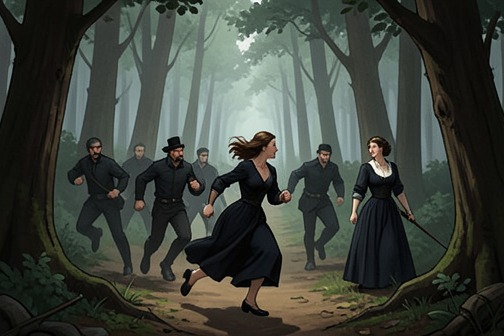
Sephy’s escape from captivity unfolds as a rupture within the hostage group’s already failing operation: she flees into the woods, encounters Callum in the darkness, and gives him information that may explain how the authorities found them. Her flight briefly turns the pursuit into a chance for reunion, but the warning she delivers also sharpens the danger around the remaining captors.
## Background and Breakdown
The escape takes place after Callum and Sephy have been reunited in captivity. Their closeness is interrupted when [Jude](entity:character-recall-character-jude-c859762b9a2d) and [Morgan](entity:character-recall-character-morgan-995ce75c13a9) burst into Sephy’s cell and find them together. The discovery changes the immediate situation: Callum is exposed in front of his fellow captors, and the private reunion becomes entangled with the kidnapping’s collapse.
The group has already suffered a major setback. Morgan reports that [Leila](entity:character-recall-character-leila-9aa2e50a07da) has been arrested, while Jude says [Pete](entity:character-recall-character-pete-20a13c365688) is dead. Jude believes undercover police were operating throughout the area and suggests that the authorities may have been monitoring phone boxes or knew where the group would be. He and Morgan changed locations at the last moment and escaped capture, but Jude’s plan to take Sephy somewhere safer has become uncertain. His account frames Sephy’s flight not as an isolated decision but as part of a crisis in which the group’s security and plans have broken down.
## Flight into the Woods
After leaving the cabin, Sephy runs through the woods, trying to get away from the men pursuing her. Callum and the others chase after her, but Callum is especially determined to reach her first. The movement separates Sephy from the cabin and from the group controlling her, even as it leaves her alone in unfamiliar darkness.
When footsteps move away, Sephy opens her eyes and finds Callum standing less than a metre from her. Their encounter reverses the immediate terms of her flight: the person she has been running from is no longer simply a captor in the scene, but the person between her and the others. Callum takes her hands, and the two briefly turn their attention to the night sky. He then tells her to go, keeping distance between them even as their meeting offers a moment for contact.
## The Warning and Its Consequences
Sephy does not leave without speaking. She recalls the blond man who came with Callum to see her and recognizes him as someone she had seen at her father’s house a couple of years earlier. She identifies the detail that convinces her: he wore boots with silver chains. Sephy is positive that the man works for her father, and she tells Callum so before he disappears into the shadows.
The warning links the immediate danger at the cabin to Sephy’s family and raises the possibility that an associate of her father has penetrated or approached the captors’ circle. Callum thanks her and vanishes; Sephy then runs. The available account establishes what she recognized and told him, but does not establish that this information alone caused the authorities to locate the group or determined what happened next.
## Narrative Significance
The escape is a divided turning point. Sephy’s flight gives her a chance to break from the cabin, while her unexpected meeting with Callum briefly renews the connection between them under conditions of danger. At the same time, she uses that encounter to pass on actionable information rather than simply seek protection. The scene moves from pursuit to recognition, then back to separation: Callum withdraws into the shadows, and Sephy runs on.
The broader collapse surrounding the escape prevents it from reading as a simple rescue. Leila’s arrest and Pete’s death have already undermined the group, and Sephy’s warning identifies a possible link between the hostage-takers and her father’s world. Her flight thus intersects personal attachment with political and operational danger, without resolving either. The scene records a precarious opening toward freedom, not a settled account of safety or reunion.
Event 21
Sephy决定生下孩子
Sephy’s decision to continue her pregnancy is a turning point in her relationship with Callum and her family: rather than accept an abortion arranged by her parents, she claims the pregnancy as the consequence of her mutual love with Callum and insists on keeping the child. The decision makes private what had been hidden impossible to contain, exposing both the tenderness of Sephy’s attachment and the racial assumptions through which her family interprets it.
## Discovery and uncertainty
After Sephy returns from captivity, her sister Minnie asks whether she is pregnant. Sephy initially denies it, but her answer falters; Minnie asks whether it could be the case and whether one of the kidnappers was responsible. The question leaves Sephy with a possibility she has not yet faced, and she runs from the conversation rather than answer it.
Sephy then uses a pregnancy test. She reads the instructions, follows them, and waits for the result, trying to reassure herself that her morning sickness is only a delayed reaction to the preceding weeks. When the indicator turns blue, the uncertainty ends: she understands that she is pregnant. The test changes the issue from a suspicion she might evade into a decision that will reshape her life.
## Her parents’ plan
Minnie has told their parents, and Sephy is called to the family room, where her mother sits beside her and her father paces. Her father says they must handle the situation quickly and discreetly. He has already booked Sephy into a clinic for the following morning and expects that by evening the pregnancy will be over, allowing the family to put the matter behind them.
Her mother presents the plan as being for the best, while her father treats it as a practical solution to a problem that has become public and difficult to manage. When Sephy asks whether they want her to have an abortion, her mother assumes she would not want the child, describing the pregnancy through the possibility that her kidnapper fathered it. Her father likewise assumes that Sephy has been harmed and says she should have told them earlier. Their plan rests on an account of the pregnancy that Sephy has not given.
## Refusal and confrontation
Sephy refuses to go to the clinic. She first says quietly that she will not attend the appointment, then makes her decision explicit: she is going to keep her baby. When her father dismisses this as unreasonable and argues that she is only eighteen and will be judged for how the child was conceived, Sephy repeats that she will keep it. Her resolve is not presented as a passing reaction; she holds to it as her parents try to define the pregnancy and its consequences for her.
The conflict sharpens when her father insists that Callum must have raped her because she is pregnant. Sephy directly rejects that claim and says that she and Callum made love to each other. She describes their night together as wonderful and says her regret is that they cannot repeat it. This disclosure clarifies what her decision means to her: she is not accepting her parents’ description of the child as a product of assault, but affirming the relationship and shared choice that led to the pregnancy.
## Consequences and significance
Sephy’s declaration does not persuade her father. He strikes her, disowns her, insults her through a racial slur, and insists that she will still go to the clinic. His response turns a family disagreement into an explicit rupture: Sephy’s decision to keep the pregnancy challenges both his authority over her future and the racial contempt shaping his account of Callum and the child.
The pregnancy decision also connects the couple’s private relationship to the larger racial hierarchy of the novel. Sephy is the daughter of [Kamal Hadley](entity:character-recall-character-kamal-hadley-0c49a552686e), while Callum is a Nought; her father’s hostility recasts their relationship as shameful and the unborn child as a threat to the family’s standing. Against that pressure, Sephy’s repeated refusal gives the pregnancy a meaning her parents cannot dictate. The scene establishes that she intends to continue it, even though doing so costs her her father’s acceptance.
Event 22
Callum在Hadley庄园被捕

[Callum’s arrest](entity:action-recall-action-callum-s-arrest-2d2a3b81aec7) at the Hadley estate turns a clandestine reunion into a sudden separation. In the rose garden beneath glass, Callum learns that Sephy is carrying their child and reaches toward a shared future; lights blaze on, he is knocked unconscious, and Sephy’s attempt to defend him is ignored as he is taken away. The scene makes love and hope briefly tangible, then exposes how little protection either has against the power surrounding the Hadley household.
## The reunion in the rose garden
Callum has slipped past a guard into the estate’s enormous greenhouse, where the entire rose garden is now enclosed under glass. The roses have grown since his last visit, which feels to him like a lifetime ago. Their stems and thorns cover the arches and wooden trellises; in the dark, the colours run together until one flower seems to melt into the next. This altered garden is at once familiar and changed, a private place preserved through time but transformed beyond recognition.
Callum wonders whether Sephy is at the house and whether she will come. When she appears, he can barely speak. Sephy whispers that he should not have come because it is not safe, but Callum says he had to and asks if what he suspects is true. Her answer confirms that she is pregnant. She embraces him, and he pulls her close; the child she is carrying is theirs. Their kiss gives physical form to the hope and regret they have brought into the meeting, while the child makes their bond consequential beyond the two of them. When Callum rests his hands on Sephy’s slightly rounded abdomen and she covers them with hers, the reunion becomes an intimate recognition of the future they share.
## A future proposed, then cut short
Sephy asks whether Callum meant it when he told her he loved her. He takes her hands, and their mutual movement toward intimacy is described as an avalanche: instead of fleeing love, they have continued running toward it. The language registers the force of their attachment while also suggesting how difficult it will be to resist the danger around them.
Callum proposes that they leave and go away together, even if only for a little while. Before he can finish, lights click on around them, dazzling and blinding. Sephy shouts for him to run. Callum raises a hand to shield his eyes, but he cannot see; something hits his head, he falls to the ground, and everything goes dark. The sudden change from a private embrace to exposed vulnerability gives the arrest its defining reversal: the possibility of escape is voiced at the very moment the lovers are prevented from acting on it.
## Arrest and Sephy’s protest
After Callum is struck down, Sephy is left to confront the consequences of his capture. She screams that the authorities have the wrong man and insists that Callum has done nothing wrong. No one listens. As police carry him away, she tries to hold on to him and pull him back, but they ignore her.
Sephy’s father drags her back inside the house and angrily tells her to stop making a spectacle of herself. She then lowers her voice and tries again, saying that she and Callum were only talking. Her change from shouting to a quieter appeal shows her trying another way to make herself heard, but it does not alter the outcome: Callum is taken away, and her testimony cannot protect him.
## Significance
The arrest breaks into the lovers’ reunion at the precise point when their relationship becomes bound to a shared child and Callum imagines escape as a real possibility. The glasshouse offers concealment only until the lights expose them; the roses’ interwoven growth offers an image of closeness, but their thorns and the estate’s security mark the danger enclosing it. Sephy’s resistance continues after Callum falls, yet her efforts to defend him are powerless against the police and her father’s authority. The scene thus shifts the story from a moment of private hope to the consequences of capture, leaving the couple’s future in the hands of forces they cannot control.
Event 23
Callum被判死刑
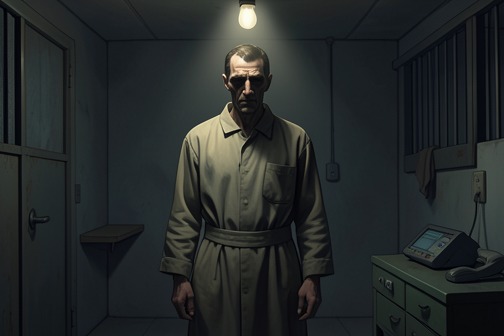
Callum’s conviction and death sentence mark the point at which the legal system turns his relationship with Sephy into part of the case against him and makes his death appear inevitable. The novel reveals the sentence through Callum’s prison reflections: after a trial he calls a farce, he believes the verdict was fixed before the jury was sworn in, while reports of Sephy’s public support cannot undo it. His approaching execution exposes how institutional power, racial hierarchy, and the denial of a fair hearing converge in one irreversible judgment.
## Background of the Case
The wider climate surrounding Callum’s case is visible in the hostility directed at Nought students admitted to Heathcroft. A crowd gathers outside the school chanting against their presence, while police try to clear a path for Callum and three other [Noughts](entity:concept-recall-concept-noughts-1aaaa6ffdea4) to enter. Callum later reads a news account that describes the day as involving “some hostility,” omitting the assaults the students faced and the police failure to protect them. The discrepancy between what happened and what the report admits establishes a pattern of public and institutional minimization that frames the trial’s injustice.
That pattern also appears inside the school’s leadership. Mr Costa suggests that if the Nought students find the school difficult, they should go elsewhere. [Mrs Paxton](entity:character-recall-character-mrs-paxton-a89c7b5539e1) counters that they are being repeatedly targeted and warns that retaliation is only a matter of time. Her concern identifies the pressure placed on the students, but the response from authority makes exclusion, rather than protection, seem like the proposed remedy. The case against Callum unfolds in a world where hostility is visible and yet readily minimized or redirected toward those subjected to it.
The institutions implicated extend beyond school and police. At a hospital, Callum’s mother is told that a government ruling requires patient identity cards to be checked and registered before medical care can be administered. This episode does not itself determine Callum’s sentence, but it adds to the novel’s depiction of state administration reaching into ordinary life. Alongside the distorted news report and the school’s response, it situates the criminal case within a society where Noughts encounter institutional control without equal protection.
## Verdict and the Denial of a Hearing
After the trial, Callum lies in his prison cell reading a newspaper. His case has slipped from the front page to the third or fourth page, but the coverage remains inaccurate. The shifting prominence does not mean that the injustice has been corrected; it means that the public’s attention has moved on while Callum remains imprisoned under the same judgment.
[Jack](entity:character-recall-character-jack-b5a26722c3ea) tells Callum that Sephy has spoken publicly against the guilty verdict and has openly said that Callum did not rape her. She has also said the authorities refused to let her testify on his behalf. Some national newspapers are beginning to question the death penalty in his case, but this developing criticism comes after the verdict and does not give Sephy the hearing she sought. Callum sees her efforts as a fight against a decision already made, not as a route to overturning it.
The contrast between Sephy’s public declaration and her exclusion from the proceedings makes the limits of post-trial protest clear. Her statement supports Callum, and even some press coverage begins to question the punishment, yet Callum believes no intervention could have changed the judges’ decision once he had been found guilty. The sentence therefore stands not merely as the outcome of a trial but as a judgment insulated from the evidence and testimony that might challenge it.
## The Sentence as Racial Judgment
Callum interprets the verdict through his relationship with Sephy. In prison, he reasons that he has been convicted because he is a Nought who dared to love a Cross, and because their relationship became physical and Sephy is pregnant with his child. He treats these facts as the deeper explanation for the judgment, not as details that would rescue him from it. The private relationship that might ordinarily be understood as a matter between two people is rendered, in Callum’s account, an offense against the racial order.
His understanding is sharpened by the way the case combines a guilty verdict with an irreversible penalty. Callum says that he knew he would hang even before the jurors were sworn in. That belief makes the trial appear predetermined in his eyes: the legal procedure has taken place, but he experiences its outcome as settled in advance by his identity and his defiance of the taboo against Nought–Cross intimacy.
The sentence also carries consequences for Sephy, whose account is not admitted when it could matter most. Her later public insistence that Callum did not rape her cannot substitute for testimony at trial. The proceedings leave her speaking outside the courtroom, while Callum faces execution inside the prison system. Their separate positions show how the conviction reaches beyond the accused: it silences a witness, confines the relationship to public scandal, and leaves their child’s existence as another fact Callum believes society condemns.
## Prison, Memory, and the Approaching Execution
Callum’s final reflections place the judgment within a narrow prison routine. He reads the newspaper to pass the time, folds it up when he has finished, and drops it into the bin beside his bed. Its reports offer little comfort: they are inaccurate, and the public debate they record cannot change his immediate circumstances. His attention turns instead to [Lynette](entity:character-recall-character-lynette-71e9799b4a32), whose memory returns more often as his own time runs short.
Callum recognizes that he had once resented Lynette for leaving him and had judged her response to her suffering through the effect it had on him. In prison, he reconsiders what she endured and admits that events had robbed him of his humanity. His former rule, “[Do unto others before they did unto you](entity:expression-recall-expression-do-unto-others-bef-524166cdd381),” had been a means of coping with the world, but he now sees Lynette’s way of withdrawing until she was ready to return as better. This change does not alter his sentence; it gives his final days a reckoning with the cost of the worldview that violence and oppression had fostered.
Callum’s final-day statements strip away the distance maintained by newspaper coverage and courtroom language. He acknowledges that he does not want to die and asks Jack for the time. The simple question makes the sentence immediate: for a prisoner expecting execution, time is no longer an abstraction but the measure of how little remains. His recognition of the impending end coexists with the conviction that the trial was unjust, leaving no reconciliation between the court’s decision and the person who must face it.
## Narrative Significance
The conviction is disclosed in fragments rather than through a single courtroom account. The reader encounters the social climate at Heathcroft, a news report that softens what occurred, the school authority’s exclusionary response, and then Callum’s retrospective understanding of a trial whose verdict he considered certain from the start. This sequence makes the sentence legible through its surrounding institutions and consequences rather than treating it as an isolated legal outcome.
The episode’s central contrast is between formal judgment and lived knowledge. The case has ended, the headlines have receded, and public criticism is only beginning, yet Callum remains condemned; meanwhile Sephy’s testimony, which could have addressed a decisive allegation, was not permitted at trial. By ending on Callum’s awareness that his last day has arrived and that he does not want to die, the narrative refuses to let the verdict’s official finality stand for justice. His sentence exposes the human cost of a system in which racial boundaries shape whose relationships are punished and whose evidence is heard.
Event 24
Callum被处以绞刑
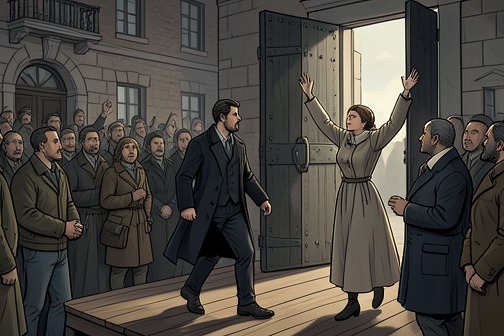
Callum’s execution is the fatal conclusion of his refusal to make the public confession [Kamal Hadley](entity:character-recall-character-kamal-hadley-0c49a552686e) demands. In the final hours of his life, the condemned Callum is led from his cell before a crowd and toward the scaffold; Sephy calls out her love, he answers, and the trapdoor opens before he can know whether she hears him.
## The Offer and Callum’s Decision
Before the execution, Kamal offers Callum a deal: he wants Callum to state publicly that he kidnapped and raped Kamal’s daughter, and to admit freely to the crimes with which he is charged. Callum asks for time to think. The demand makes the decision explicit: a public admission might alter his immediate fate, but it would require him to affirm the account Kamal insists upon.
Callum describes the choice as one he will have to live or die with. He looks Kamal in the eye and makes his decision, believing it will damn him but that it is right. The evidence does not spell out the decision separately, but the scene places it against Kamal’s demand for an admission, and the subsequent narration moves directly to Callum’s last day. The execution therefore follows a refusal to purchase life by publicly confessing as Kamal demands.
## The Last Day in Prison
Callum recognizes that his time is nearly over: he says that he has come to his last day on earth. At the prison, the security door clicks at the end of the corridor. [Jack](entity:character-recall-character-jack-b5a26722c3ea) rises and goes out to stand beside Callum’s open cell door. Governor Giustini stops outside, looks at the cards scattered across the floor and bed, and then looks at Callum. These ordinary details remain in view as the formal process of the execution begins.
As Callum is taken from the cell, voices call anonymously from other cells along the corridor. He considers turning to look at the people behind the calls, but decides there is not enough time. He keeps his gaze ahead. The brief moment makes the prison corridor a final boundary: the voices register other prisoners’ presence, while Callum’s attention is already fixed on the passage out.
## The Scaffold and Final Words
The door at the end of the corridor opens onto bright sunshine. Outside, Callum stops at the sight of a large crowd, larger even than the crowd present when his father was about to be hanged. Many of those watching are [Crosses](entity:concept-recall-concept-crosses-47abf27d378b), gathered to see the execution. The sun dazzles him, and the scaffolding obstructs his view; above it, the noose sways in the evening breeze. The scene brings the public spectacle of state punishment into sharp contrast with the private exchange Callum is about to have with Sephy.
Sephy calls out, “I LOVE YOU, CALLUM …” Callum answers, “I … I LOVE YOU TOO, SEPHY …” and repeats that he loves her. His words reach toward Sephy in front of the watching crowd, but the narration leaves uncertain whether she can hear him. The trapdoor opens, ending their exchange. Callum drops, and his words die on his lips.
## Aftermath and Narrative Significance
The final thought is a plea that Callum heard Sephy. It does not confirm whether he did; the scene closes on the uncertainty that separates them at the moment of death. The execution thus ends not with a settled answer between the two characters but with Callum’s last hope that her love reached him.
The contrast between Kamal’s proposed public confession and the lovers’ final words defines the event’s stakes. Callum’s choice is presented as a matter of conscience, while the scaffold turns his death into a public display. The crowd, the prison’s anonymous calls, and the brief declarations of love place state punishment beside human connection, making the execution both the end of Callum’s life and the closing interruption of his relationship with Sephy.
Event 25
Callie Rose出生
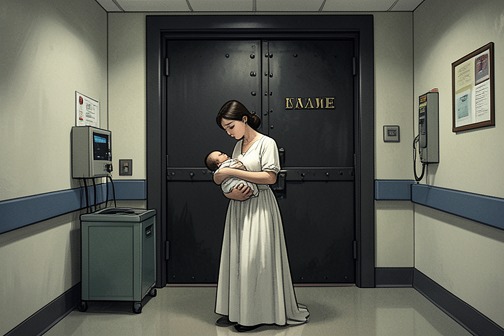
Callie Rose’s birth, announced at Mercy Community Hospital on 14 May, closes the novel by giving [Persephone Hadley](entity:character-recall-character-persephone-hadley-eb8440fea67a) and the deceased [Callum McGregor](entity:character-recall-character-callum-mcgregor-50a89b03e1a0) a daughter—and by carrying Callum’s family name into the next generation. The brief public notice records both the child’s arrival and Persephone’s decision that she will be known as [Callie Rose McGregor](entity:character-recall-character-callie-rose-mcgrego-6cee926aba53).
## The announcement
The novel presents the birth through a pair of formal notices rather than a narrated delivery scene. The first states that Persephone Hadley gave birth at midnight on 14 May at Mercy Community Hospital to a daughter, Callie Rose, and identifies Callum McGregor as deceased. The next notice adds that Persephone wishes her daughter to take her father’s name, McGregor.
That spare, public format supplies the essential facts without describing the birth itself. It also makes the child’s naming an explicit choice: although Callum is absent and dead, his surname is not allowed to disappear from his daughter’s identity.
## The losses behind the birth
The announcement follows Callum’s execution by hanging. At the prison, Persephone sees him among those gathered to witness the execution of his father, [Ryan Callum McGregor](entity:character-recall-character-ryan-callum-mcgrego-e821a2e56c1d); later, Callum recalls that Ryan’s death in July has left something inside him dead. Callum himself is executed after the couple’s final reunion, and Persephone’s shouted declaration of love is cut off as the trapdoor opens.
The birth notice therefore places a new life directly beside the fact of Callum’s death. Its description of him as deceased is restrained and administrative, in sharp contrast with the emotional intensity of their final moments. The text does not state how Persephone reaches the decision to use his surname, but the notice makes that decision unmistakable.
## Family name and ending
By choosing McGregor for Callie Rose, Persephone preserves a public connection between her daughter and Callum. The name does not undo his execution or restore the family life they could not share; instead, it gives their child a continuing link to him after his death.
As the novel’s closing narrative detail, the announcement shifts attention from the lovers’ separation to the child who survives them. Callie Rose’s birth ends the story not with the restoration of what was lost, but with a new generation bearing the name of the man who is gone.
Event 26
Jude持枪闯入Sephy的住所
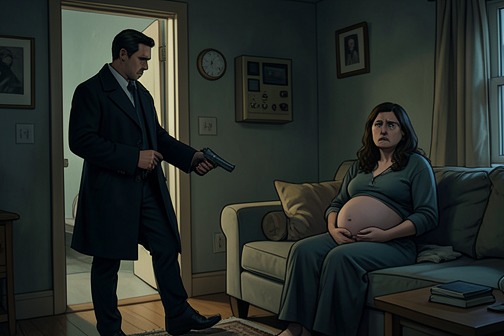
[Jude](entity:character-recall-character-jude-c859762b9a2d)’s armed arrival at [Sephy’s flat](entity:location-recall-location-sephy-s-flat-033b5bc656fa) brings his pursuit of revenge for Callum’s death into direct confrontation with Sephy and her sister [Minerva](entity:character-recall-character-minerva-fc023ce135f2). He enters intending to kill Sephy, but she recognizes why he has come and asks him to spare Minerva, transforming the threatened attack into a tense struggle over who will bear the cost of his grief.
## Background and Approach
Jude’s plan is shaped by his conviction that Sephy is responsible for Callum’s death. On a cold, dark February night, he follows her from a car, keeping a short distance behind and driving without lights. Sephy is heavily pregnant and carrying two shopping bags. Jude’s surveillance is deliberate: he intends to conceal his presence until he decides that the time is right to act.
His thoughts reduce the history between the families to a demand for reciprocal loss. He identifies Sephy as the Cross girl whose presence, in his view, brought devastation to his family, and then as the person responsible for Callum’s death. The progression from accusation to intended punishment establishes the logic driving his approach: he treats Sephy’s life as payment for his brother’s.
The date gives that plan a further personal meaning. Sephy realizes Jude has followed her for two or three days and has chosen [Callum’s birthday](entity:time-recall-time-callum-s-birthday-050f14bf1594) to make his move. She understands the intended timing as symbolic: Callum did not live to see another birthday, and Jude means for Sephy not to survive until hers. The threat is therefore not presented as an impulsive encounter; it is a planned act of vengeance organized around the anniversary of Callum’s birth.
## The Armed Confrontation
A loud knock at the door interrupts the sisters’ conversation. Sephy’s expression shifts to resignation, and she beckons Minerva toward the door. When Minerva objects to the stranger entering, Jude produces an automatic gun. His arrival immediately changes the sisters’ situation from an unexpected interruption to a life-threatening confrontation.
Jude had not expected Minerva to be present. He regards her presence as an additional opportunity to hurt their father by putting both daughters at risk. Minerva is frightened by the gun, while Sephy’s response surprises him: she does not appear afraid. Her composure frustrates the reaction he wants from her, and she instead concentrates on Minerva’s safety.
Sephy tells Jude that Minerva has nothing to do with his grievance and that he wants her, not her sister. When Jude asks whether she knows why he is there, Sephy says she has recognized his surveillance and anticipated that he would choose that day. She then states plainly to Minerva that Jude has come to kill her. The explanation exposes the threat to Minerva and confirms that Sephy has understood both Jude’s purpose and the significance of the occasion.
## Callum’s Birthday and the Threat
Sephy identifies Callum’s birthday as Jude’s reason for acting that night. The disclosure gives Minerva an answer to why the attack is happening now, and it makes the conflict’s central contradiction explicit: Jude invokes his brother’s memory to justify killing Sephy, while Sephy’s awareness of that memory helps her anticipate the attempt.
Sephy also tries to shape the timing of the threatened killing. She notes that it is just after half past ten and suggests Jude may intend to shoot her shortly before midnight, making her death a symbolic present to Callum. She presents this as a way of understanding the revenge he has planned, while telling him she will not run, raise the alarm, or act foolishly. Minerva hears enough to grasp that Sephy expects Jude to kill her and fears she may be next. The sisters’ responses thus diverge: Sephy addresses Jude directly, while Minerva remains frightened and uncertain whether Sephy has a plan or is trying to delay him.
## Stakes and Significance
The encounter places revenge and protection in direct opposition. Jude arrives treating Sephy as the person who must answer for Callum’s death, but Sephy’s first clear appeal is to release Minerva from a conflict that is not hers. The gun gives Jude immediate power over both sisters; Sephy’s understanding of his motives allows her to speak to the terms of his plan, but the scene leaves Minerva unsure whether this is an attempt to buy time.
The birthday also connects the confrontation to the story’s earlier losses without resolving them. Jude turns remembrance into a proposed act of retaliation, while Sephy names the grief and symbolism underpinning his choice. By bringing Minerva unexpectedly into the situation, the planned attack threatens to extend the family’s cycle of loss beyond its intended target. The scene establishes the immediate stakes of Jude’s visit and the sisters’ unequal positions within it, but this portion ends before the outcome of the confrontation is known.
Event 27
绑架珀塞芬·哈德利
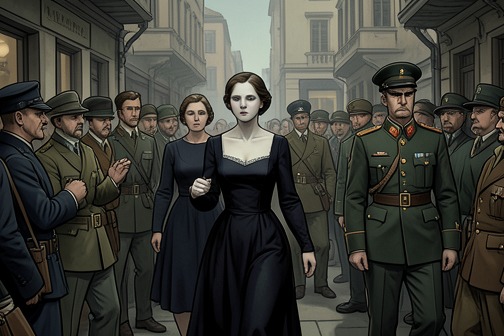
The kidnapping of [Persephone Hadley](entity:character-recall-character-persephone-hadley-eb8440fea67a) was a Liberation Militia operation aimed at making a political statement and striking at [Kamal Hadley](entity:character-recall-character-kamal-hadley-0c49a552686e) through his daughter. Its failure, exposed betrayal, and unexpected intimacy between Persephone and [Callum McGregor](entity:character-recall-character-callum-mcgregor-50a89b03e1a0) bound a militant campaign to the personal tragedy that followed.
## Causes and Objectives
The kidnapping was directed against Kamal Hadley, a Cross politician whom the Militia regarded as hostile to noughts and their cause. Callum’s account identifies the plan as having two purposes: to make a political statement and to hurt Kamal personally by taking his daughter. The choice of Persephone therefore made the operation both a public act of resistance and a direct attack on a powerful political family.
## Betrayal and the Failed Operation
The plan went disastrously wrong because [Andrew Dorn](entity:character-recall-character-andrew-dorn-0192cfab2eb9), the Militia’s second-in-command, was working with the Cross authorities, particularly Kamal. Callum later believed that Dorn’s betrayal had exposed the operation and led to the deaths or capture of every member of his assigned cell apart from Callum and [Morgan](entity:character-recall-character-morgan-995ce75c13a9). The kidnapping thus became evidence of a deeper security crisis: a trusted figure high in the organization had turned against it, and Callum did not know where Dorn was or how to reach him.
## Captivity and Relationship
During her captivity, Persephone and Callum’s relationship changed decisively. She later told [Jude](entity:character-recall-character-jude-c859762b9a2d) that, on the night Callum went to collect the ransom money from her father, Callum told her he loved her and the two made love. Persephone insisted that their love was mutual and pointed to her pregnancy as proof. The revelation contradicted Jude’s accusation that Callum had only pretended to love her, and it connected the kidnapping to the child Persephone was carrying.
## Aftermath and Significance
The operation’s failure had consequences beyond the loss of the cell. Callum described the police crackdown, large rewards for information leading to the capture and conviction of Militia members, and the organization’s growing status as a hunted group. After Callum’s death, the authorities’ actions also made him a martyr in the eyes of many noughts, intensifying demands for reprisals. The kidnapping therefore linked political resistance, betrayal, and state repression to a private bond that endured beyond captivity, while helping set in motion the later cycle of grief and revenge.